
Crazy Horse
c. 1840-1877. Oglala Lakota war leader
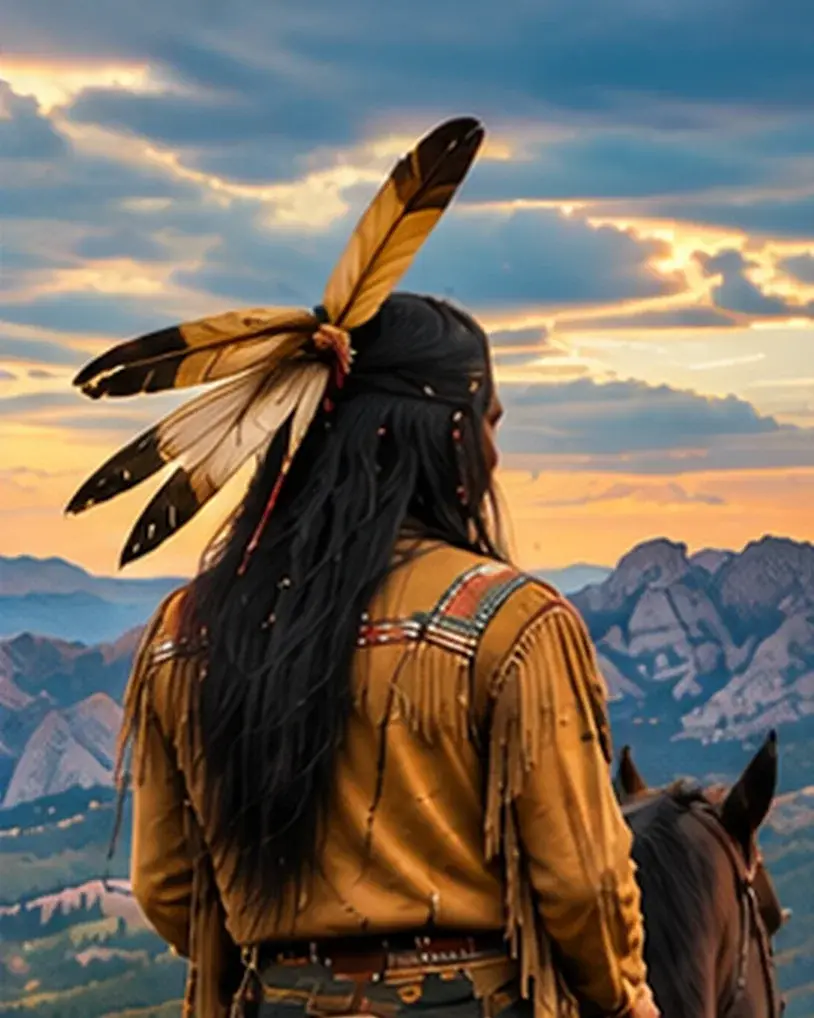
Crazy Horse is one of the most written-about Lakota leaders and among the least securely documented. Most sources question whether he was ever photographed, and no authenticated picture of him is known. The illustration on this page is AI-generated and shows no face for that reason. The tintype sometimes promoted as his likeness is disputed.
The Black Hills connection
He was born around 1840. The Encyclopedia of the Great Plains places his birth near Bear Butte, while other sources say near Rapid Creek in the Black Hills. Either way, his origins lie in this country. His father was an Oglala warrior and medicine man, also named Crazy Horse, and his mother a Miniconjou Lakota woman called Rattle Blanket Woman.
War leader
He fought in the Fetterman Fight of 1866 and in the fights of 1867 at Fort Phil Kearny during Red Cloud’s War. When Red Cloud and other chiefs signed the 1868 treaty, he refused to recognize it. That same year he was chosen as an Oglala head warrior, or shirt-wearer, a position he lost in 1870 or 1871, depending on the source, after Black Buffalo Woman left her husband for him and the husband shot him in the face.
Gold and the Hills
The 1874 gold discovery, and the government’s attempt to buy the Hills, angered nearly all Lakota leaders. In December 1875 Lakota bands were ordered to report to reservations or face military action, and in March 1876 the Army attacked a Northern Cheyenne village it mistook for his. On June 17, 1876, he led about 1,500 warriors against General Crook on Rosebud Creek, and on June 25 he was among the leaders at the Little Bighorn, the Greasy Grass.
No source consulted quotes him directly on the sale of the Black Hills, so this profile does not offer such a quotation.
Fort Robinson
With the Army’s winter campaign pressing, he surrendered at Fort Robinson, Nebraska, in May 1877; sources give May 6 or 7. Rumors spread by rival chiefs that he planned to escape reached junior officers, who ordered his arrest. On September 5, 1877, during the attempt to imprison him, a soldier bayoneted him, and he died a few hours later. Witness accounts of that struggle differ. He left two wives; his only child, a daughter named They Are Afraid of Her, had died around 1873.