
Paha Sapa: The Lakota Homeland
Before it was a gold field, the Black Hills were and are sacred Lakota homeland. How the land was promised, taken and never sold.
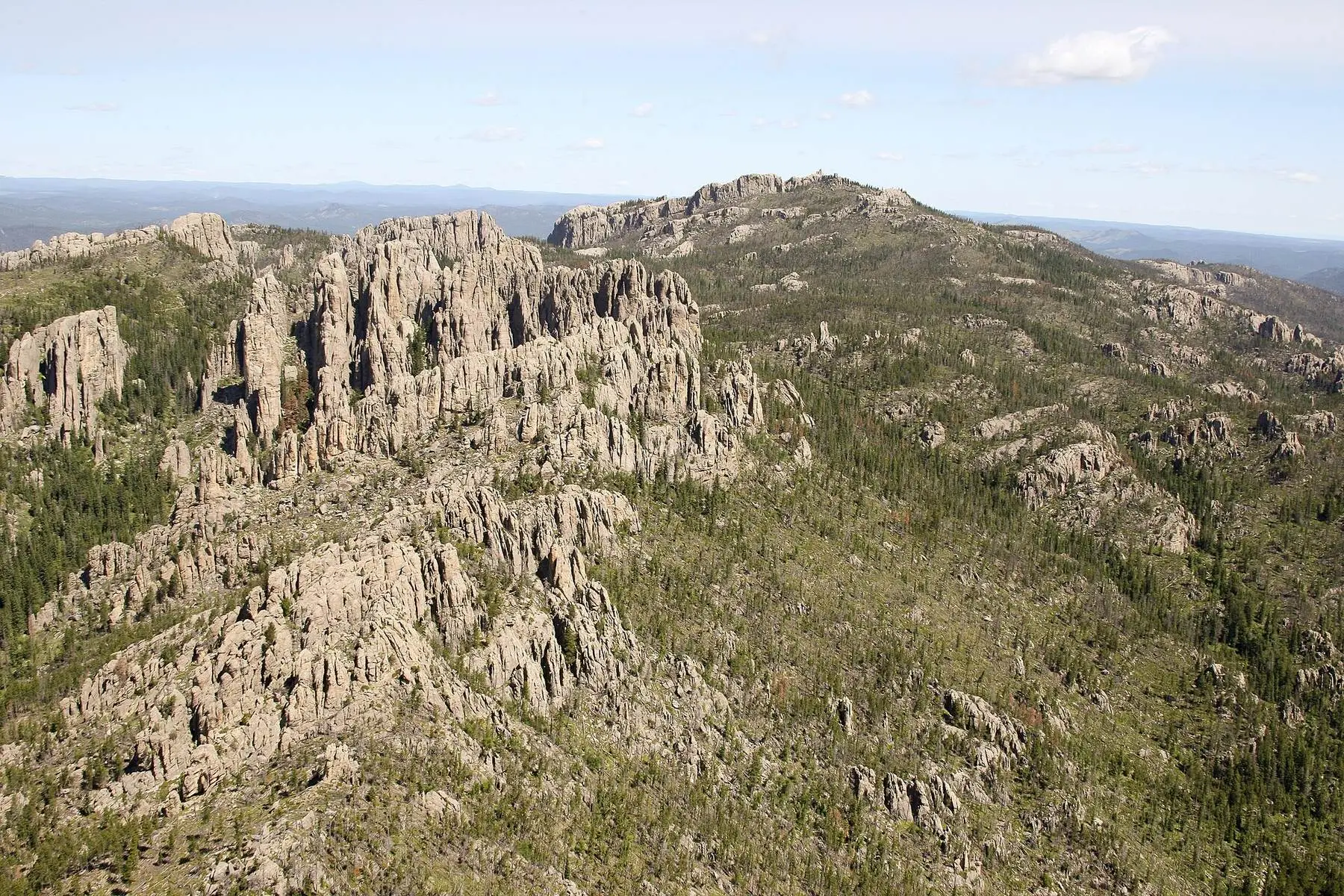
Deadwood’s own Historic Preservation Office now says it plainly: the town began as an unauthorized settlement on land the 1868 Treaty of Fort Laramie had granted to the Lakota. Any honest history of this place starts there, and starts earlier.
The heart of everything
The Lakota call these mountains He Sapa or Paha Sapa, which mean “Black Mountains” and “Black Hills,” and also know them as Wamakaognaka E’cante, “the heart of everything that is.” Jace DeCory, a Lakota scholar at Black Hills State University, has described the Hills as “the heart of everything for the Lakota people.” The National Park Service says Native people have lived here since time immemorial, and researchers count about 4,000 archaeological sites spanning some 12,000 years.
The sacred geography is specific. Wind Cave, Oniya Oshoka, is where many Lakota place the emergence of their people and of the bison. One telling, from Oglala tribal historian Wilmer Mesteth and shared on the park’s website, follows the first people out of an underground spirit lodge, with bison at the center of the lesson. Versions vary by band and family, and DeCory has noted the idea of emergence is not limited to one spot. Bear Butte, which the Lakota call Mato Paha and the Cheyenne call Noahvose, is where people have come for thousands of years to fast, pray and seek visions. The Park Service also describes a seasonal ceremonial route through the Hills, including Pe’ Sla, following a star map between the spring equinox and the summer solstice. Black Elk, the Oglala holy man, placed the great vision of his childhood at the peak that now carries his name.
Treaties
The United States first made written promises about this land at Fort Laramie in 1851. In 1857 Lakota leaders met at Bear Butte to discuss the growing number of settlers. After fighting from 1865 to 1867, the treaty signed on April 29, 1868, set apart the Great Sioux Reservation, with the Black Hills inside it, for the tribes’ “absolute and undisturbed use and occupation.” It required the agreement of three-fourths of adult men for any future land cession. Not everyone accepted it. Sitting Bull refused to take part, and Crazy Horse would not recognize it.
Sources describe the acreage differently, and the 60 million acre figure is attached to both treaties in different accounts. What they agree on is the promise.
Six years
The promise held for six years. In 1874 Lt. Col. George Custer led close to 1,000 men into the Hills, and the expedition confirmed gold by mid-August. The National Park Service says the miners who followed were in direct violation of the treaty. For a while the Army tried to remove trespassers. In 1875 a federal commission offered $6 million to buy the Hills or $400,000 a year to rent them, and the Sioux asked $70 million. When talks collapsed, President Grant called a meeting on November 3 to find another way, and the Army stopped holding miners back. On December 6 agents were ordered to send word that all Lakota must report to reservations by January 31, 1876, or be treated as enemies.
War followed, including the destruction of Custer’s command at the Greasy Grass in June 1876. In its aftermath Congress cut off subsistence funds until the Sioux gave up the Hills, and a commission presented a prepared agreement. The Park Service says the chiefs and headmen who signed that October were forced. By the Supreme Court’s count, about ten percent of adult Sioux men signed, not three-fourths. Congress made it law anyway on February 28, 1877.
The case
The Sioux pursued a legal claim for decades. On June 30, 1980, in United States v. Sioux Nation of Indians, the Supreme Court affirmed that the 1877 Act was a taking that required just compensation: $17.1 million, the value of the Hills in 1877, plus interest. The opinion rejected any presumption of congressional good faith as a way of ending the inquiry.
The award did not return any land. Depending on the source, it is described as $102 million, $105 million or $106 million at the time. The money has sat in trust ever since, growing to more than $1 billion by a PBS account in 2011.
Why the money sits there
The Sioux tribes have refused it. Mario Gonzalez, general counsel for the Oglala Sioux Tribe, has said the tribes have held since 1877 that the seizure was illegal. Theresa Two Bulls, a former Oglala Sioux Tribe president, explained that taking the money would end the government’s treaty obligations. Rosebud Sioux chairman Rodney Bordeaux has said the same and noted that the tribes seek federally held lands rather than the whole region. Opinion is not unanimous, and PBS reported that younger tribal members were more open to accepting. A lawsuit filed by individual members in 2009 sought to distribute the money, and the Rosebud council opposed it.
In 2012 tribes raised $9 million to buy Pe’ Sla when it came up for sale, buying back part of what the treaty had once promised. In March 2016 the Bureau of Indian Affairs decided to place 2,022 acres in trust. That August, the state’s highest point was renamed Black Elk Peak.
For a visitor to Deadwood, none of this is background. The street you are on, and the story the town tells about itself, stand on land whose ownership the Sioux have never conceded.
Sources
- Black Hills, Sacred Land Film Project
- History and Culture, Wind Cave National Park, National Park Service
- The Lakota Emergence Story, Wind Cave National Park, National Park Service
- Stone Hoop Garden: A Living Memorial, Mount Rushmore NM, National Park Service
- Sacred Native American Sites: Bear Butte and Wind Cave, National Trust for Historic Preservation
- "We are all mitakuye oyasin," Sanford Underground Research Facility
- Treaty of Fort Laramie (1868), National Archives
- United States v. Sioux Nation of Indians, 448 U.S. 371 (1980), Legal Information Institute
- Story of the Battle, Little Bighorn Battlefield NM, National Park Service
- Sitting Bull, Little Bighorn Battlefield NM, National Park Service
- President Ulysses S. Grant and Federal Indian Policy, National Park Service
- Fort Laramie in 1876, National Park Service
- Black Elk, National Park Service
- Why the Sioux Are Refusing $1.3 Billion, PBS NewsHour
- Black Hills background, PBS NewsHour
- Rosebud tribe battles Black Hills lawsuit, ICT
- Tribes raise $9M for sacred SD land, MPR News
- Pe' Sla trust decision, Indianz.com
- City of Deadwood's Sesquicentennial Celebration
- No Where to Be Found: Myth, Mapping, Empire, and Resistance in the Black Hills Country, South Dakota History 51:2 (note on He Sapa, Paha Sapa and Wamakaognaka E'cante)