
Fire, Flood and Rebuilding
Deadwood has been knocked down repeatedly. The fires of 1879, 1889, 1894 and 1987 and the flood of 1883 shaped the town you see today.
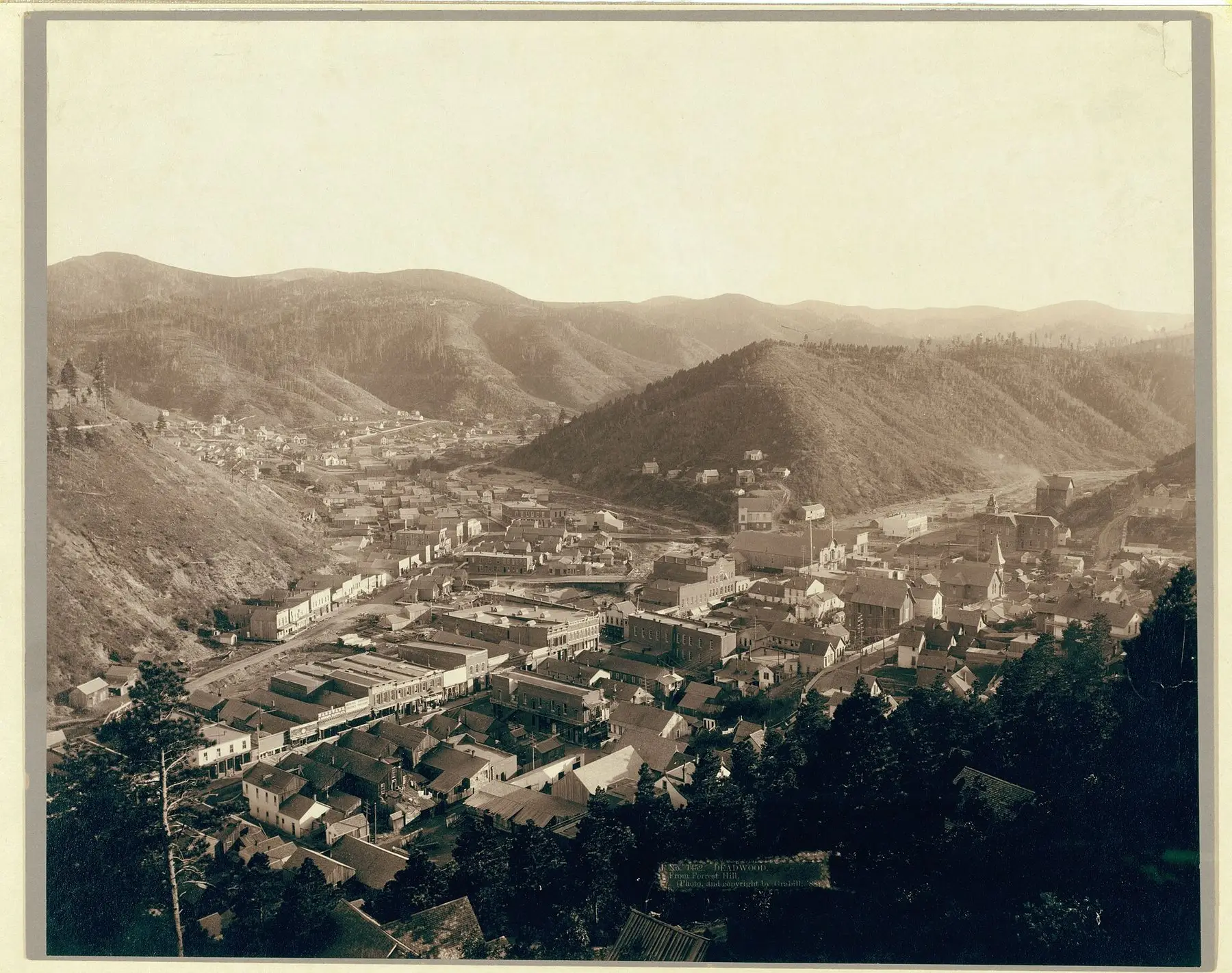
Deadwood sits in a narrow gulch, built largely of wood at first, on creeks that run hard in spring. That is a poor combination. Historian David Wolff’s article in South Dakota History argues that fires in 1879, 1889, 1894 and 1987 changed the town, in part for the better, as residents and leaders responded creatively.
September 26, 1879
The Great Fire started before dawn at Mrs. Ellsner’s Empire Bakery on Sherman Street, when a coal oil lamp fell over. Sources differ on the hour, 2:30 or 3:30 a.m. The pine walls lined with canvas caught at once. The fire reached Jensen and Bliss Hardware, where eight kegs of black powder exploded and threw burning debris across town. Prairie Public reports that volunteer hose teams had hoses too short to reach Whitewood Creek, and that the town had no water system yet; the city’s own timeline shows a water company franchise granted that same month.
More than 300 buildings burned and nearly 2,000 people were left homeless. The Black Hills Pioneer has put the loss at about $1 million in 1879 money, and names one casualty, a man known as Casino Jack, who apparently slept through the alarms. The Gem Theater was among the losses, as was the Adams brothers’ Banner Grocery.
What came next is the key to modern Deadwood. Some residents left for good. Others, as Prairie Public tells it, began rebuilding the next day, in brick and stone. The 1985 National Register nomination says the core of the city dates from after the 1879 fire and before the panic of 1893. Swearengen reopened a larger Gem by December. Bullock and Star rebuilt their hardware store in brick in early 1880.
The flood of 1883
In May 1883 water did what fire had not. The U.S. Geological Survey calls 1883 a benchmark flood year in the northern Black Hills, caused by heavy rain on top of snowmelt. The Survey’s photo captions date it May 17, and the city’s timeline May 18. The Park Service’s landmark study records 150 buildings destroyed and three lives lost, and the city says the flood washed away most of the town. Its nomination form lists the fire, the flood and the panic of 1893 as the disasters that left few wooden-front buildings from the 1876 to 1883 period standing.
1889, 1893 and 1894
Wolff counts an 1889 fire among his four. The silver depression of 1893 hit hard. The Park Service study says that the population fell suddenly from 25,000 to 1,000, numbers that are hard to credit given the town’s size, but the blow itself was real. Reduction plants for low-grade ore on the edge of town helped carry the town through.
On March 5, 1894, fire destroyed the lower business district of Main Street, an area known as the Badlands. It took Bullock and Star’s hardware store. Their brick warehouse survived, and they rebuilt it as a three-story hotel with a new stone front, with Boulder Canyon stone tooled in Sturgis. One source says it opened in 1896. Local sources disagree about whether the Gem burned in 1894 too. It certainly burned on December 19, 1899, and Swearengen, by then short of money, did not rebuild it.
On lower Main Street the same period saw a busy Chinese neighborhood, whose physical traces also disappeared over time. Sanborn fire insurance maps show it by name from 1885, and Wing Tsue’s emporium advertised silk and dry goods in 1898. Archaeologists began to dig there in 2001. The Wing Tsue building itself was demolished illegally on December 24, 2005; some of its bricks went into the rebuilt Chinese altar and oven in Mount Moriah’s Section 6 in 2013.
1952 and 1987
Fire came for civic buildings too. On January 28, 1952, it destroyed City Hall, where Theodore Roosevelt had spoken in 1892, and the Deadwood Theater. Two major wildland fires threatened the town later, on September 8, 1959, and again from June 29 to July 8, 2002, when the Grizzly Gulch fire burned over 11,000 acres.
The last of Wolff’s four came on December 15, 1987, when the Syndicate Block fire destroyed three buildings on Main Street. South Dakota Public Broadcasting says it set the stage for Deadwood’s turn toward gaming, and the city calls it the rallying cry.
The result
The National Historic Landmark designation of July 4, 1961, recognized what the fires had left behind: a dense collection of Victorian-era commercial buildings on Main Street and historic houses on the hillsides. Gaming later paid for their restoration. The buildings you see on Main Street today are, in large part, the buildings put up by people who had just lost everything.
Sources
- South Dakota History explores Deadwood fires, South Dakota Historical Society Foundation
- From Disaster to Prosperity: Four Fires that Changed Deadwood, South Dakota History
- Deadwood Fire, Dakota Datebook, Prairie Public
- The great fire of Deadwood, Black Hills Pioneer
- Timeline of Deadwood, South Dakota, City of Deadwood Historic Preservation Office
- Deadwood Historic District, National Historic Landmark nomination, National Park Service
- Deadwood Historic District National Register nomination form (1985), City of Deadwood
- Black Hills Area Floods, 1877 to 1890, U.S. Geological Survey
- Flood, Deadwood (picture 1), U.S. Geological Survey
- Deadwood's Bullock Hotel continues to stand as monument, Mitchell Republic
- Bullock Hotel, Wikipedia
- Gem Theater (Deadwood, South Dakota), Wikipedia
- The Man Behind the Museum: W.E. Adams, South Dakota Public Broadcasting
- Outlaw Square, City of Deadwood
- The Archaeology of Deadwood's Chinatown: A Prologue, South Dakota History 33:4
- Mt. Moriah Cemetery brochure, City of Deadwood Archives
- How the 1987 fire changed the city of Deadwood, South Dakota Public Broadcasting
- The Town That Took a Chance, American Heritage
- In 30 years, gaming has revitalized and challenged Deadwood, South Dakota News Watch
- A National Historic Landmark, City of Deadwood
- With Old West charm, Deadwood draws people in, The Municipal (quotes Deadwood's preservation officer: July 4, 1961)