
The Gold Rush and the Founding of Deadwood
How an illegal rush onto treaty land became a town of thousands in a matter of months, and how its first year played out.
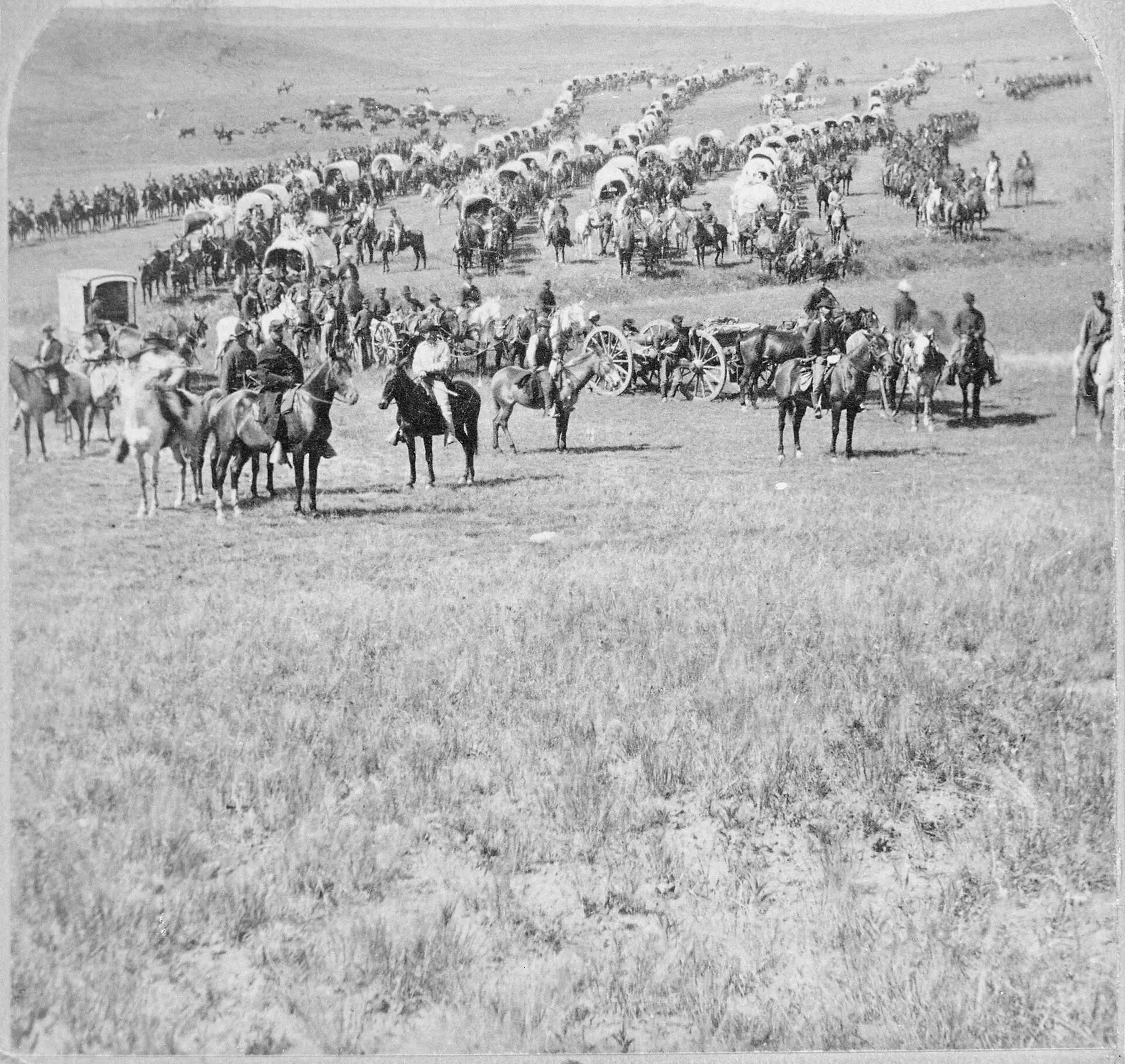
The Black Hills gold rush was illegal from the start. The 1868 Treaty of Fort Laramie reserved the Hills for the Sioux, and the National Park Service describes the miners who poured in after 1874 as being in direct violation of it. Deadwood’s own Historic Preservation Office now calls the town an unauthorized settlement. That origin explains a great deal of what happened next.
Finding the gold
The chain begins with Lt. Col. George Custer’s expedition, which left Fort Abraham Lincoln on July 2, 1874, with close to 1,000 men. It confirmed gold on French Creek in the southern Hills by mid-August, and Custer’s reports drove public demand to open the region. For a time the Army still tried to enforce the treaty, but in 1875 President Grant’s administration stopped resisting the miners.
The richest ground was farther north. In August 1875 Frank Bryant, John B. Pearson and others prospected near the mouth of Whitewood Creek, and in November Bryant returned to stake a discovery claim. The first men in, according to the Park Service’s landmark study, dug above a mat of dead timber that filled the gulch and quickly claimed all the easily reached ground. Latecomers forced to clear that debris found very rich placers underneath. The City of Deadwood says gold was found less than 100 feet from where three creeks meet, near today’s Outlaw Square, in late 1875.
Seven camps
By spring 1876 seven mining camps lined the gulch: Montana City, Fountain City, Elizabethtown, Deadwood City, South Deadwood, Ingleside and Cleveland. Tents and log cabins went up along a trail cleared of stumps that served as the street.
The date of Deadwood’s founding depends on the source. Many give April 1876. The landmark nomination says a townsite was laid out on August 26, which may be an error given that it also has the first newspaper appearing in June. The camps did not formally consolidate into a municipality until February 1881. By then, the Park Service reports, the Black Hills Pioneer had long been in print. It first appeared on June 8, 1876, and six weeks later it said the community had about 2,000 people. The Park Service study also speaks of 7,000 miners in that first spring. Reliable headcounts do not exist. Getting there was hard: routes ran from Bismarck, Fort Pierre, Sidney and Cheyenne.
Who came
Everyone came. Among the first Chinese arrivals noted in newspapers were people on the Cheyenne stage in January 1876, followed by a steady flow from 1877. Merchants came too. E.B. Farnum opened a general store. Seth Bullock and Sol Star arrived from Montana with a load of hardware in August.
Charlie Utter’s wagon train came in June or July, depending on the source, bringing Wild Bill Hickok and Calamity Jane. Al Swearengen had reached town that spring and was building the Gem, a saloon, theater and brothel that opened by April 1877.
The month of August
Few places have had an August like Deadwood’s in 1876. On the 2nd, Jack McCall shot Hickok at the No. 10 Saloon. On the 3rd, an improvised court acquitted McCall in about two hours, and Hickok was buried. On the 18th, Farnum won the mayor’s race with 672 of 1,139 votes. On the 20th, the Methodist preacher Henry Weston Smith was killed on the road to Crook City. The Chamber of Commerce’s history says the McCall verdict convinced people that they needed real law.
The problem was legal as much as moral. The camp was on land the treaty reserved, so none of its courts or offices had standing. Encyclopedia.com’s account of the McCall trials explains that this is why the acquittal could be set aside and McCall tried again in Yankton, where he was convicted in December and hanged on March 1, 1877. Farnum’s government went ahead anyway, with a pest house, a school and a fire department before the year was out. A telegraph line connected the camp to Cheyenne on December 1.
Becoming legal
Only after Congress took the Black Hills on February 28, 1877, could Lawrence County be organized, that April. Governor John Pennington appointed Bullock as its first sheriff. Whatever the settlers thought they had built, it now had the force of American law behind it, and the Sioux claim did not go away. Prospectors soon gave way to corporate lode mining, and the wide-open placer days were short. The town that those first camps created would be tested by fire within three years.
Sources
- Deadwood's Al Swearingen, HistoryNet
- United States v. Sioux Nation of Indians, 448 U.S. 371 (1980), Legal Information Institute
- Story of the Battle, Little Bighorn Battlefield NM, National Park Service
- President Ulysses S. Grant and Federal Indian Policy, National Park Service
- Timeline of Deadwood, South Dakota, City of Deadwood Historic Preservation Office
- Deadwood Historic District, National Historic Landmark nomination, National Park Service
- City of Deadwood's Sesquicentennial Celebration
- Outlaw Square, City of Deadwood
- James Butler "Wild Bill" Hickok brochure, City of Deadwood Archives
- Martha "Calamity Jane" Canary brochure, City of Deadwood Archives
- Calamity Jane: Heroine of the West or Ordinary Woman?, WyoHistory.org
- Wild Bill Hickok in Deadwood, South Dakota Public Broadcasting
- Wild Bill Hickok, Wikipedia
- Seth Bullock brochure, City of Deadwood Archives
- Seth Bullock, Wikipedia
- John "Jack" McCall Trials: 1876, Encyclopedia.com
- Jack McCall, Wikipedia
- Deadwood's first mayor, Black Hills Pioneer
- E. B. Farnum, Wikipedia
- Gem Theater (Deadwood, South Dakota), Wikipedia
- Infamous Deadwood: Sheriff Seth Bullock, Deadwood Chamber of Commerce
- The Archaeology of Deadwood's Chinatown: A Prologue, South Dakota History 33:4
- Deadwood, South Dakota, Wikipedia