
Deadwood Through Time
Scroll through the eras, or pick one. Open any entry for the full story and its sources.
Lakota Lands
Paha Sapa, sacred homeland, and the treaties.
Since time immemorialPaha Sapa, the Black Hills
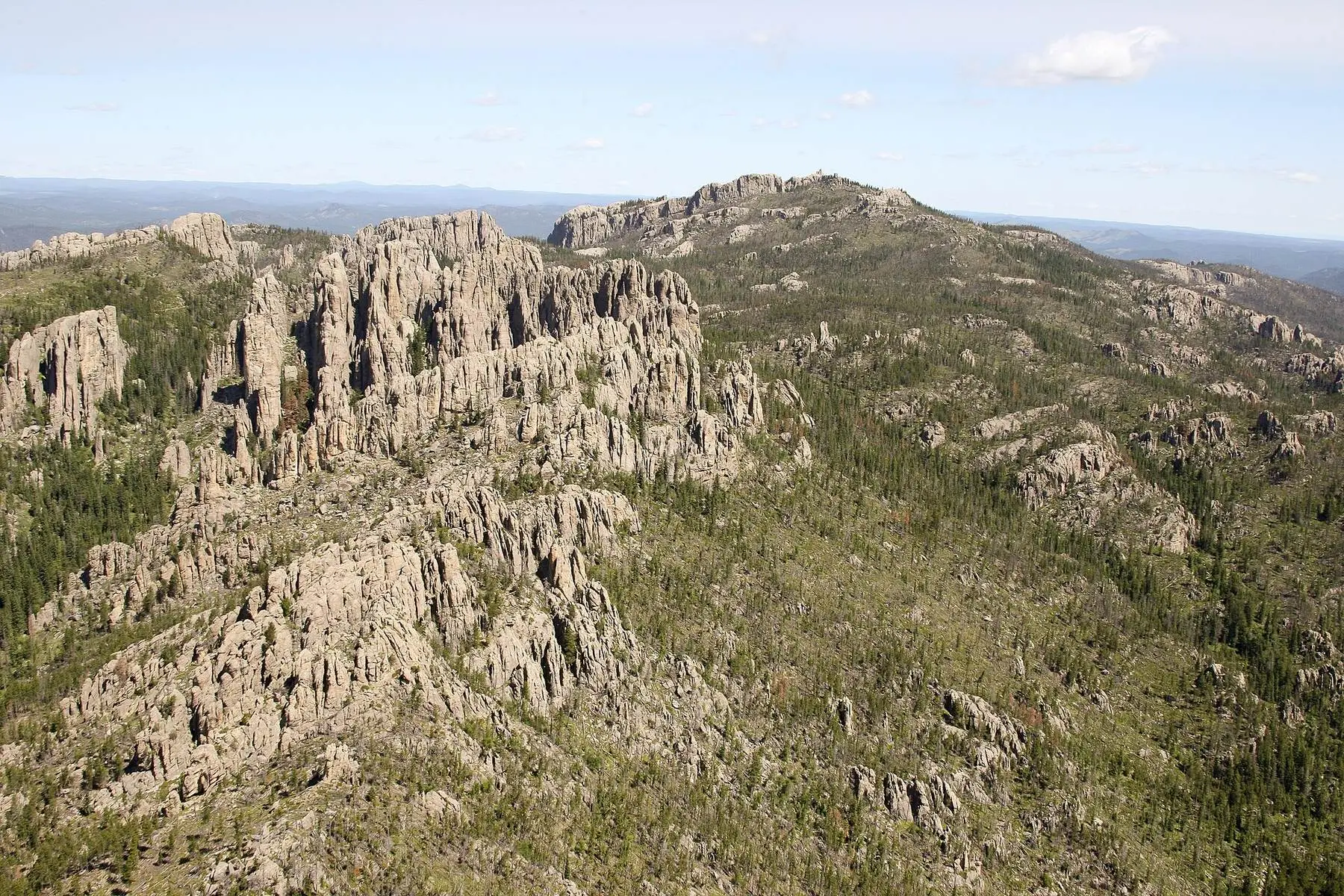
Black Hills National Forest, public domain The Lakota call these mountains He Sapa or Paha Sapa, "Black Mountains" or "Black Hills," and also Wamakaognaka E'cante, "the heart of everything that is." The National Park Service says Native people have lived here since time immemorial, and researchers count about 4,000 archaeological sites reaching back some 12,000 years. Each year spiritual leaders traced a ceremonial route through the Hills between the spring equinox and the summer solstice. For Lakota people this remains sacred homeland, not a chapter that ended.
Read more: Paha Sapa: The Lakota Homeland
Sources: Black Hills, Sacred Land Film Project, History and Culture, Wind Cave National Park, National Park Service, Stone Hoop Garden: A Living Memorial, Mount Rushmore NM, National Park Service, "We are all mitakuye oyasin," Sanford Underground Research Facility, No Where to Be Found: Myth, Mapping, Empire, and Resistance in the Black Hills Country, South Dakota History 51:2 (note on He Sapa, Paha Sapa and Wamakaognaka E'cante)
Lakota oral traditionEmergence at Wind Cave
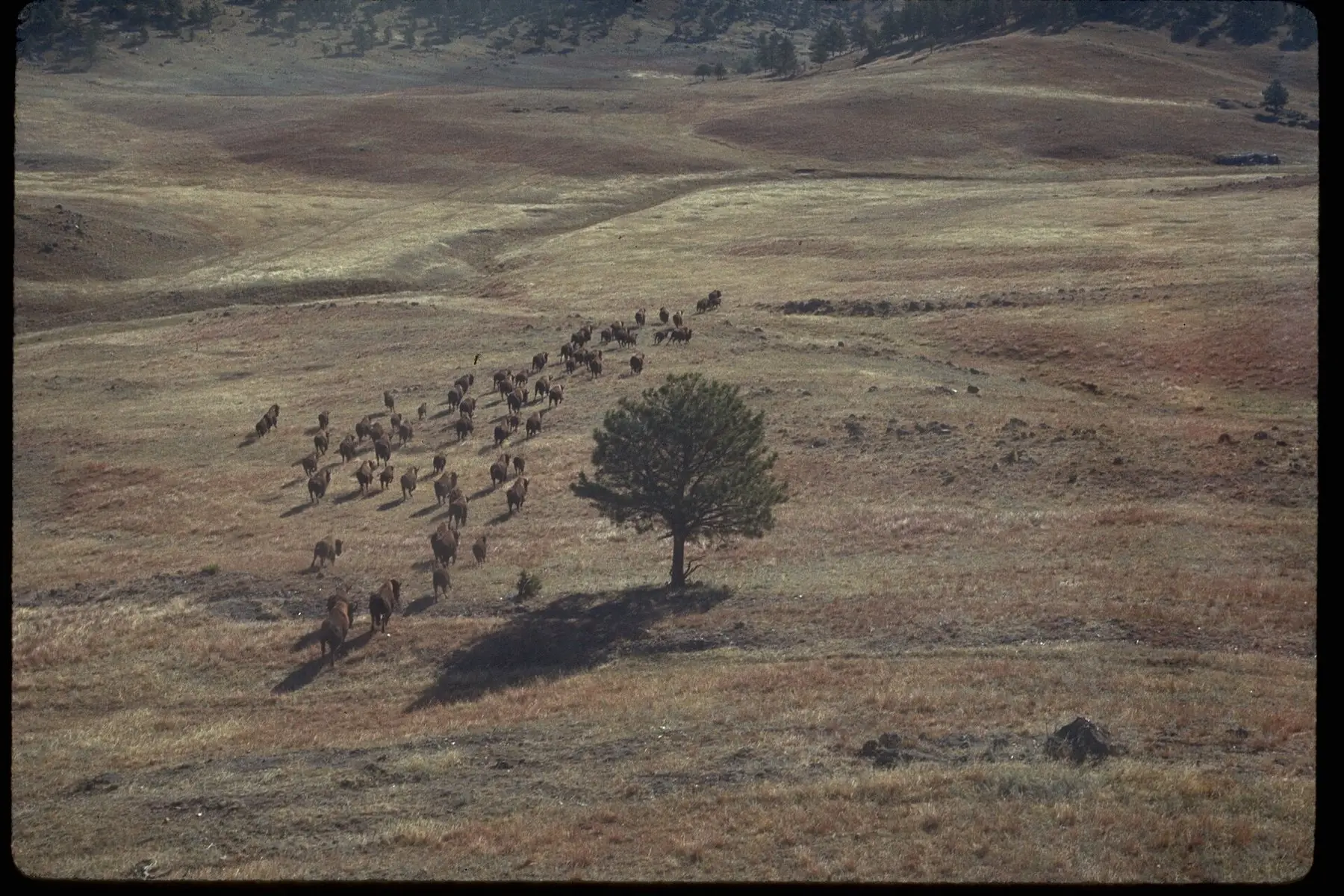
National Park Service Digital Image Archives, public domain In Lakota tradition, people and the bison are bound together at Oniya Oshoka, the place now called Wind Cave; the National Park Service glosses its other name, Maka Oniye, as "breathing earth." One version, told by Oglala tribal historian Wilmer Mesteth, follows the first people from an underground spirit lodge to the surface. Tellings differ by band and family, and Lakota scholar Jace DeCory notes that the idea of emergence matters as much as any one site.
Read more: Paha Sapa: The Lakota Homeland
Sources: The Lakota Emergence Story, Wind Cave National Park, National Park Service, Sacred Native American Sites: Bear Butte and Wind Cave, National Trust for Historic Preservation, Stone Hoop Garden: A Living Memorial, Mount Rushmore NM, National Park Service
1851First Fort Laramie Treaty
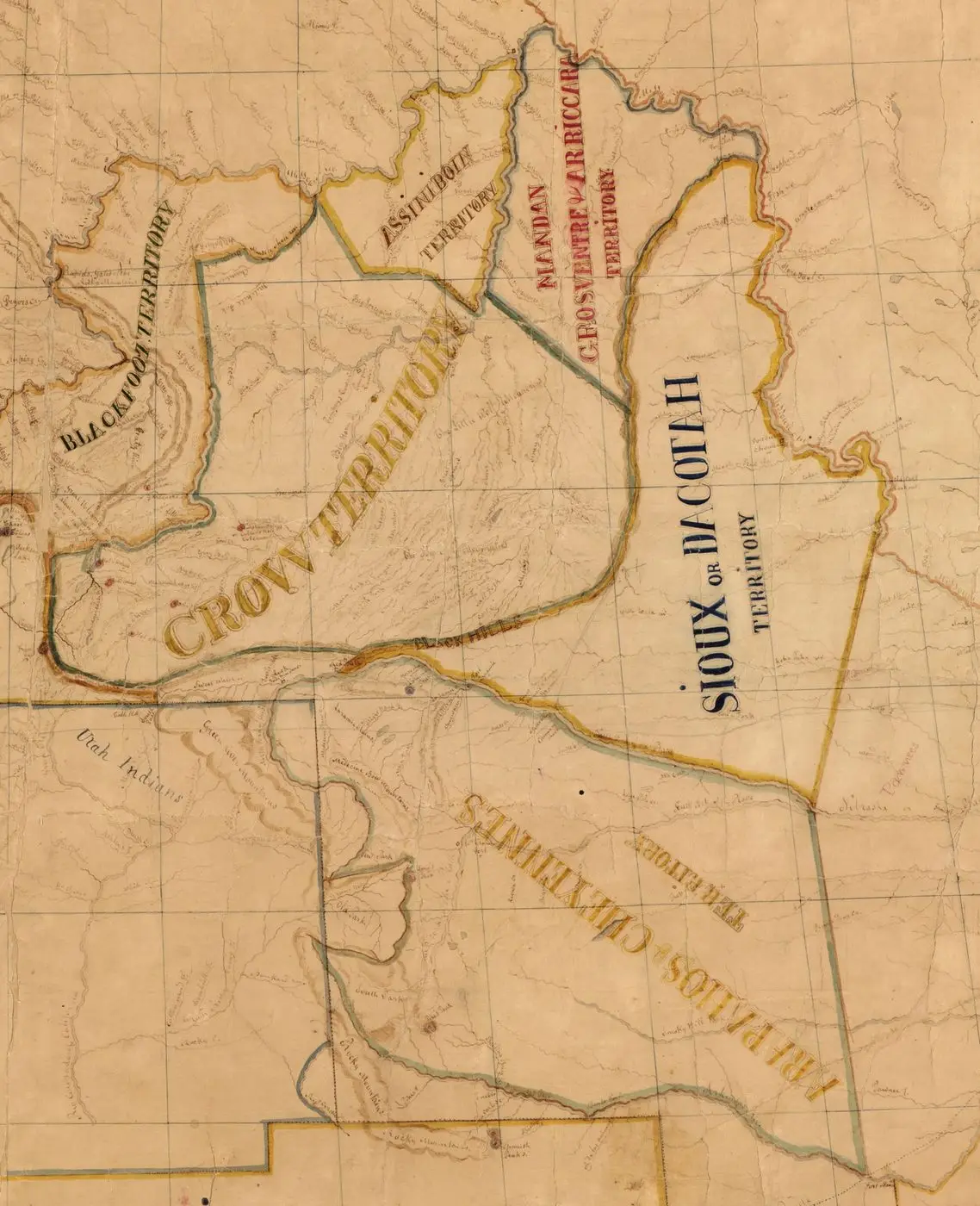
Pierre-Jean De Smet, public domain The first treaty signed at Fort Laramie promised Sioux bands a vast territory that included the Black Hills. The Sacred Land Film Project puts it at 60 million acres. A Lakota scholar quoted by Sanford Lab attaches the same acreage to the 1868 treaty instead, a difference worth noting. By 1868, the Sacred Land account says, the land base had been cut to 20 million acres.
Read more: Paha Sapa: The Lakota Homeland
Sources: Black Hills, Sacred Land Film Project, "We are all mitakuye oyasin," Sanford Underground Research Facility, Treaty of Fort Laramie, September 17, 1851, transcription, littlebighorn.info, Treaty of Fort Laramie (1868), National Archives
1857Council at Bear Butte
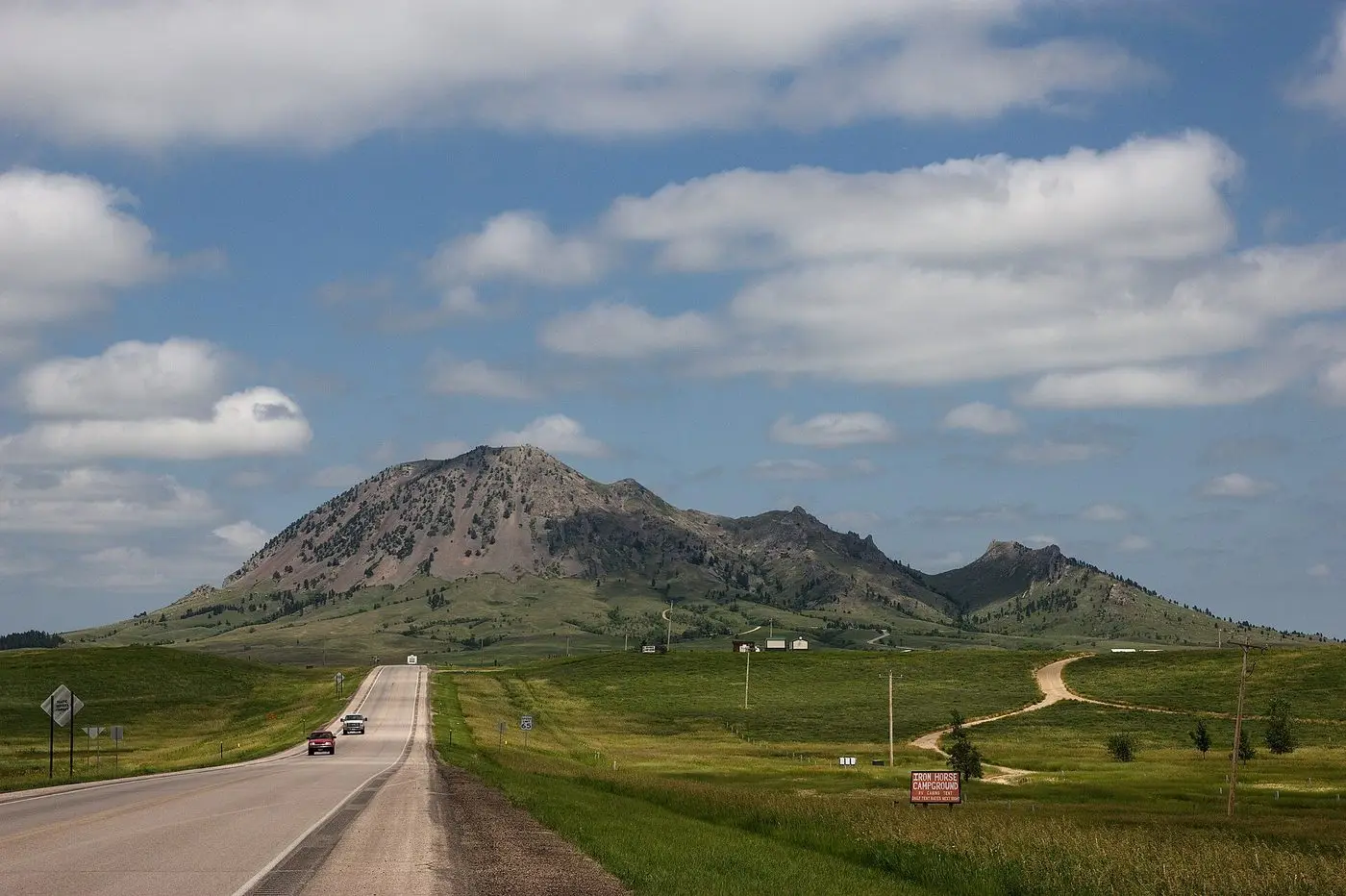
William Neuheisel, CC BY 2.0 Lakota leaders met at Bear Butte, Mato Paha, at the edge of the Hills, to talk over the growing number of white settlers. For thousands of years people have come to the butte to fast, pray and seek visions. It became a state park in 1961, and in 1982 Lakota and Cheyenne elders sued South Dakota over expansion plans. The court ruled against full, unrestricted religious use of the site.
Read more: Paha Sapa: The Lakota Homeland
Sources: Black Hills, Sacred Land Film Project, Sacred Native American Sites: Bear Butte and Wind Cave, National Trust for Historic Preservation
April 29, 1868The 1868 Treaty of Fort Laramie
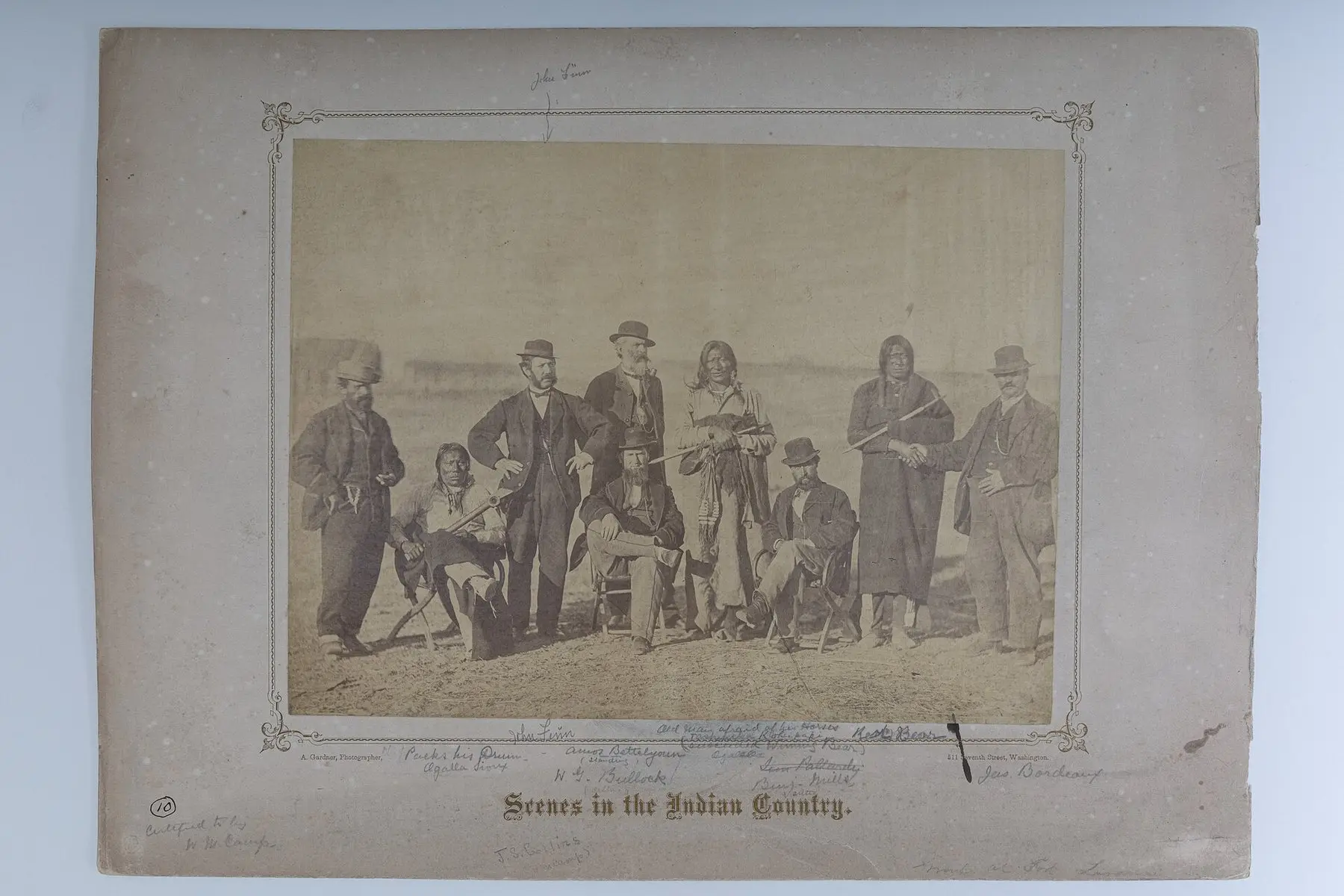
Alexander Gardner, public domain After fighting from 1865 to 1867, the United States and Lakota, Dakota and Arapaho leaders signed a treaty creating the Great Sioux Reservation, including the Black Hills, for their "absolute and undisturbed use and occupation." Future cessions would need three-fourths of adult men. Sitting Bull and Crazy Horse would not recognize it. The National Archives dates the signing April 29 and says ownership of the Hills remains in dispute; the city timeline gives April 9.
Read more: Sitting Bull, Crazy Horse, Paha Sapa: The Lakota Homeland
Sources: Treaty of Fort Laramie (1868), National Archives, United States v. Sioux Nation of Indians, 448 U.S. 371 (1980), Legal Information Institute, Sitting Bull, Little Bighorn Battlefield NM, National Park Service, Crazy Horse, Encyclopedia of the Great Plains, Story of the Battle, Little Bighorn Battlefield NM, National Park Service, President Ulysses S. Grant and Federal Indian Policy, National Park Service, Timeline of Deadwood, South Dakota, City of Deadwood Historic Preservation Office
Expedition & Gold Rush
Custer, gold, and a rush into treaty land.
July 2 to August 30, 1874Custer enters the Hills
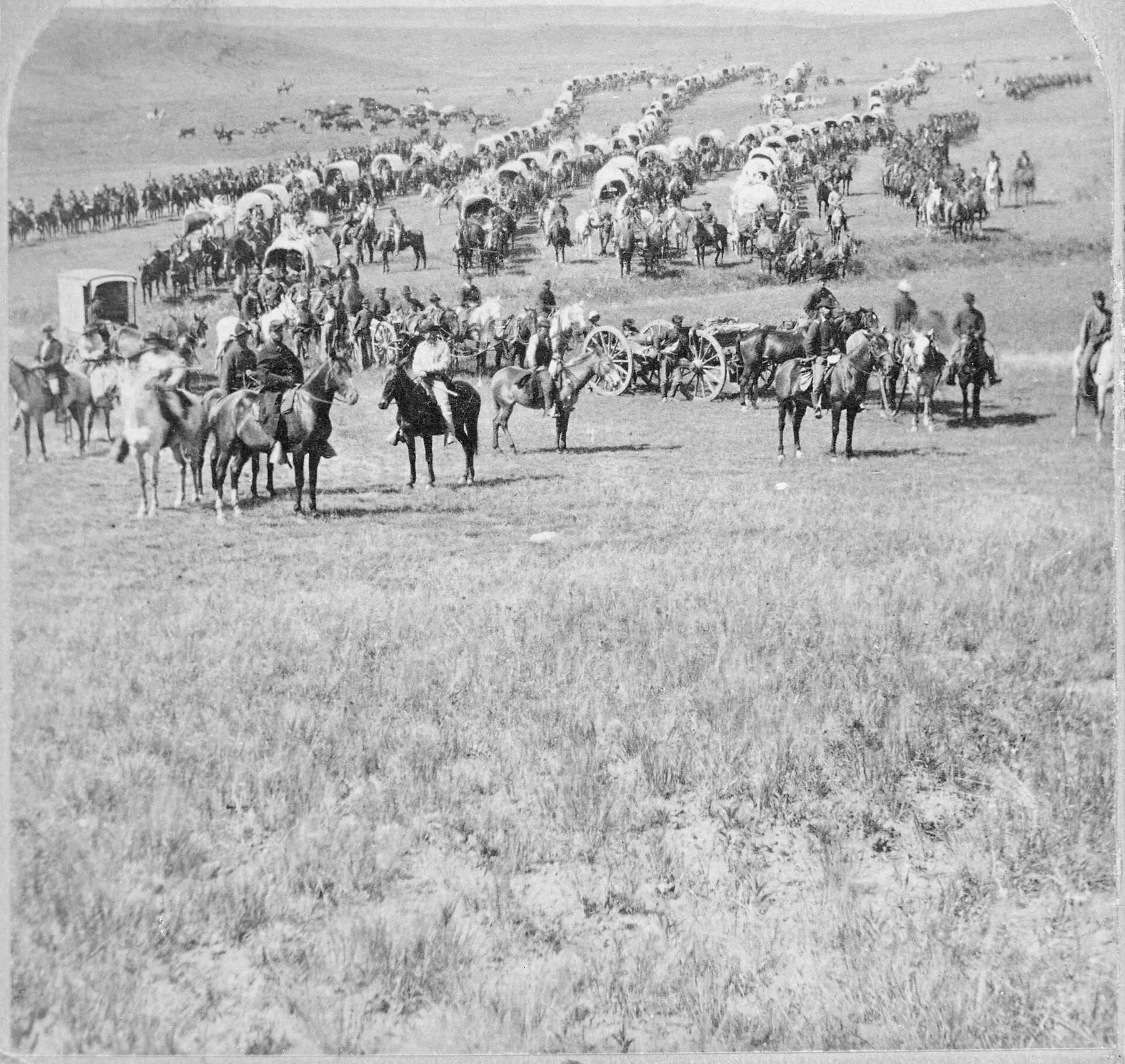
Public domain Lt. Col. George Custer led close to 1,000 soldiers and teamsters from Fort Abraham Lincoln into land the 1868 treaty had reserved for the Sioux. By mid-August the expedition had confirmed gold on French Creek, and his reports fed a national clamor to open the Hills. The National Park Service states plainly that the miners who followed were in direct violation of the treaty.
Read more: Paha Sapa: The Lakota Homeland, The Gold Rush and the Founding of Deadwood
Sources: United States v. Sioux Nation of Indians, 448 U.S. 371 (1980), Legal Information Institute, Timeline of Deadwood, South Dakota, City of Deadwood Historic Preservation Office, Story of the Battle, Little Bighorn Battlefield NM, National Park Service, President Ulysses S. Grant and Federal Indian Policy, National Park Service
1875The Lakota refuse to sell
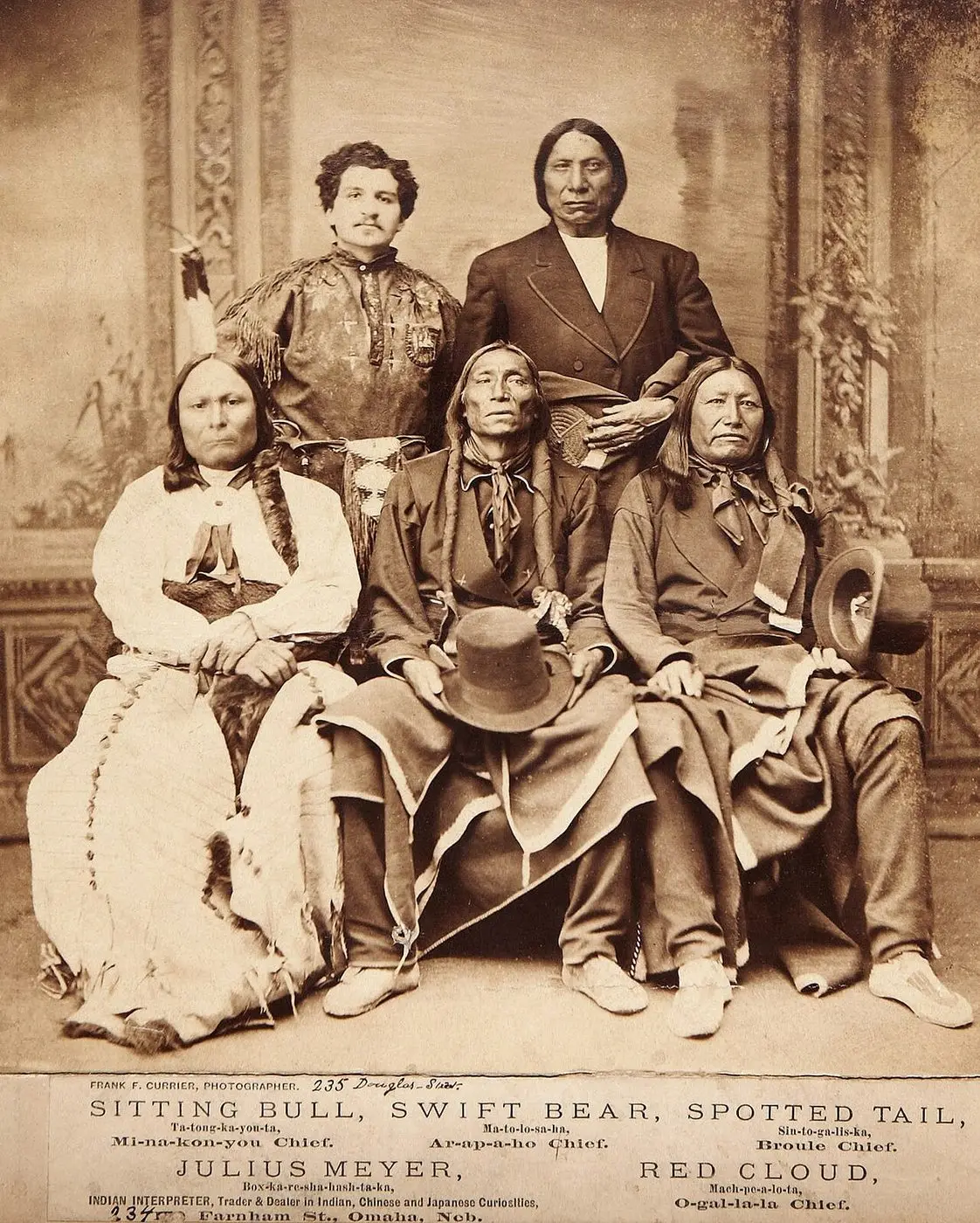
Frank F. Currier, public domain A federal commission offered $6 million for the Black Hills, or $400,000 a year to rent them. The Sioux wanted $70 million, and the talks collapsed. On November 3, President Grant called a meeting to work out how to take the land anyway. Soon afterward the Army stopped turning miners back, ending its enforcement of the treaty against trespassers. The Park Service records that the tribes had simply refused to sell.
Read more: Paha Sapa: The Lakota Homeland, The Gold Rush and the Founding of Deadwood
Sources: United States v. Sioux Nation of Indians, 448 U.S. 371 (1980), Legal Information Institute, President Ulysses S. Grant and Federal Indian Policy, National Park Service
Fall 1875Gold in Deadwood Gulch
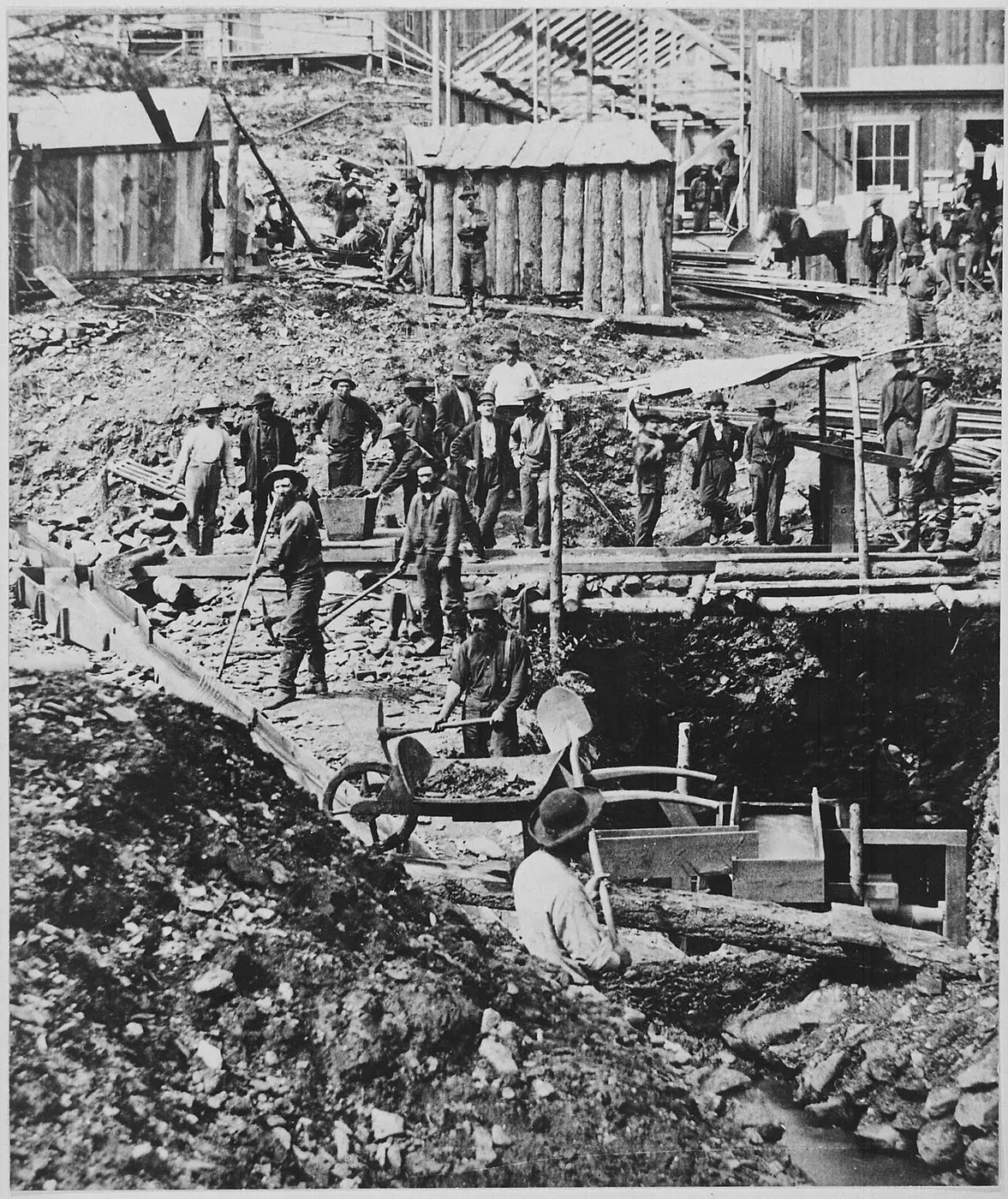
S. J. Morrow, public domain Prospectors worked the mouth of Whitewood Creek in 1875, among them Frank Bryant and John B. Pearson, on land still reserved by treaty. The Park Service's landmark study says the first men dug above a mat of dead timber that filled the gulch. Later arrivals, forced to clear that debris, found very rich placer gravel beneath it. The city dates the Deadwood Gulch discovery to fall 1875.
Read more: The Gold Rush and the Founding of Deadwood
Sources: Deadwood Historic District, National Historic Landmark nomination, National Park Service, Timeline of Deadwood, South Dakota, City of Deadwood Historic Preservation Office, Outlaw Square, City of Deadwood
December 6, 1875The January ultimatum
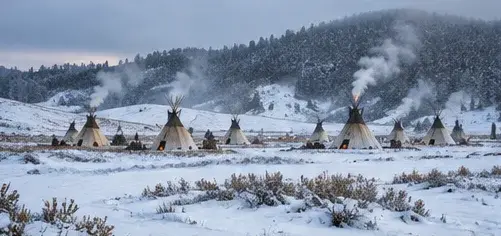
AI-generated illustration, not a historical photo. At President Grant's order, agents sent runners to Lakota hunting camps with a demand: come in to the reservations by January 31, 1876, or be treated as enemies of the United States. The Park Service says almost no one responded. When the deadline passed the Army took over, and generals Crook and Terry began their campaigns that spring. Those who stayed out were labeled "hostiles."
Read more: Sitting Bull, Crazy Horse, Paha Sapa: The Lakota Homeland
Sources: Fort Laramie in 1876, National Park Service, Story of the Battle, Little Bighorn Battlefield NM, National Park Service, Sitting Bull, Little Bighorn Battlefield NM, National Park Service
Spring 1876A camp becomes a town
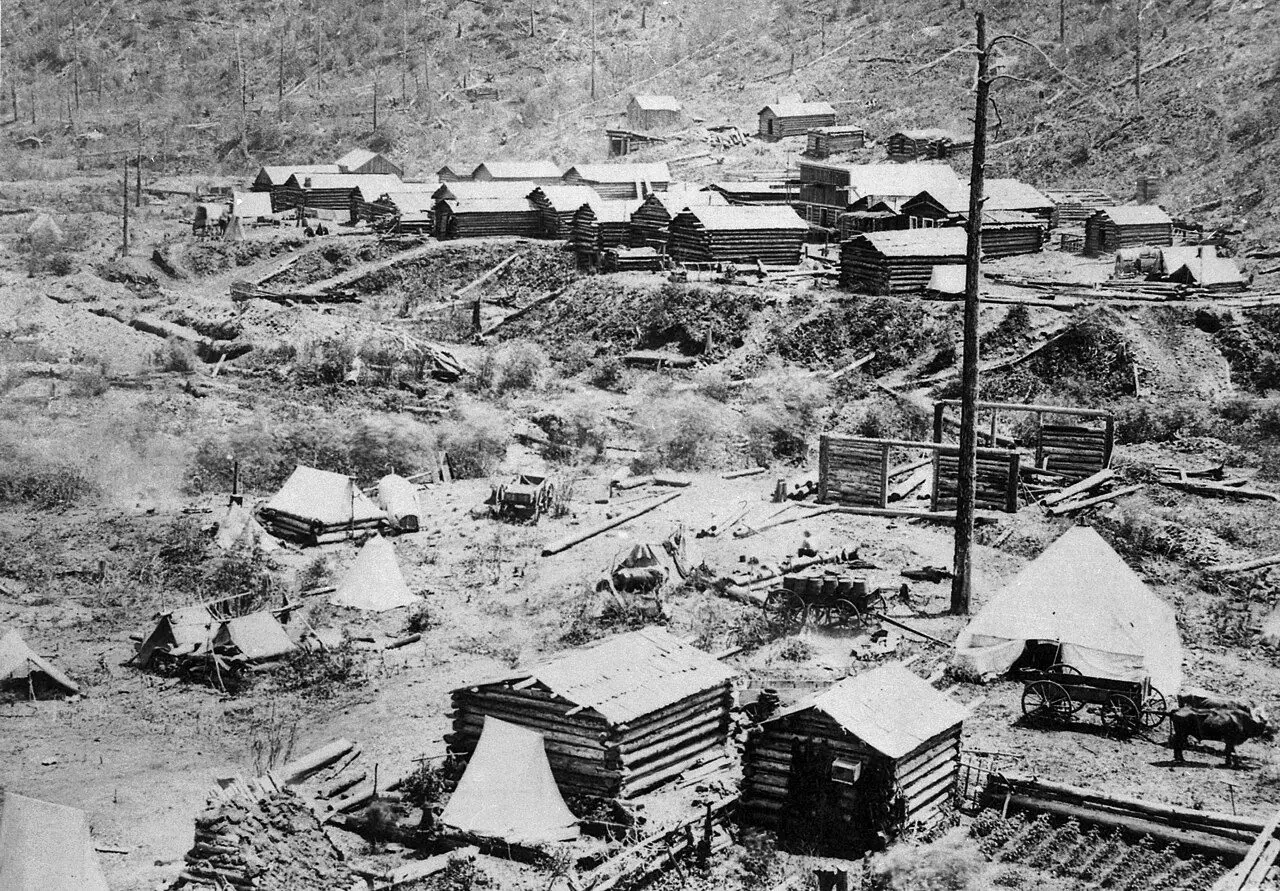
Unknown, public domain By spring seven camps crowded the gulch: Montana City, Fountain City, Elizabethtown, Deadwood City, South Deadwood, Ingleside and Cleveland. Sources date the town itself differently. Some give April 1876, while the Park Service nomination says a townsite was laid out on August 26. The Black Hills Pioneer, first printed June 8, soon counted about 2,000 residents. The city's sesquicentennial page calls it an unauthorized settlement on land granted to the Lakota.
Read more: The Gold Rush and the Founding of Deadwood
Sources: Timeline of Deadwood, South Dakota, City of Deadwood Historic Preservation Office, Deadwood Historic District, National Historic Landmark nomination, National Park Service, City of Deadwood's Sesquicentennial Celebration, Deadwood, South Dakota, Wikipedia
June 25-26, 1876Greasy Grass
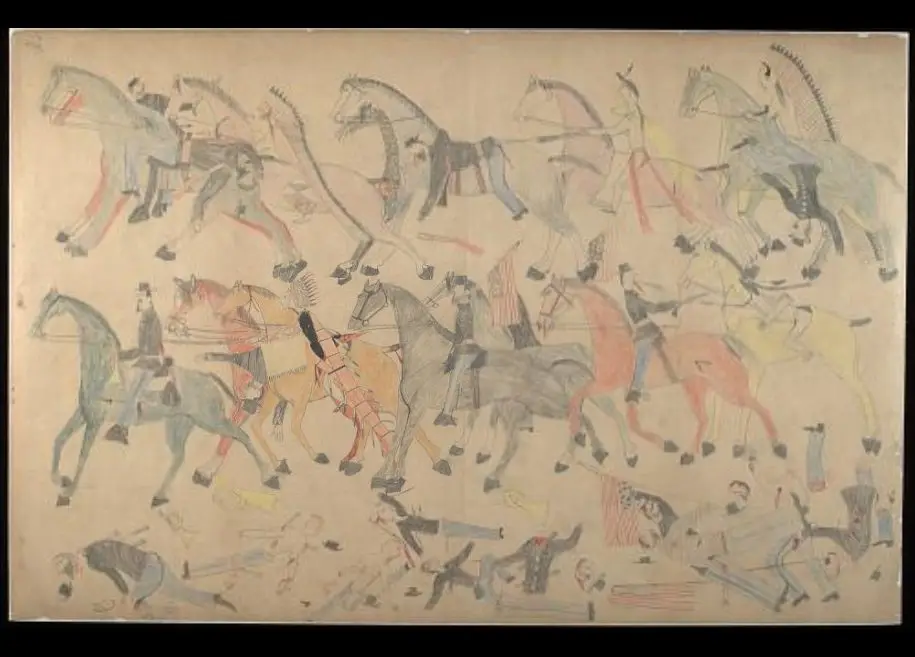
Red Horse, public domain Far to the northwest, on the river many Lakota know as the Greasy Grass, Custer's 7th Cavalry attacked a large Lakota and Cheyenne village. The Park Service reports that Custer and 267 others in his force were killed, in fighting that included leaders such as Crazy Horse and Gall. Sitting Bull, whose camp it was, did not fight himself. Young Black Elk was there too, at twelve.
Read more: Sitting Bull, Crazy Horse, Paha Sapa: The Lakota Homeland
Sources: President Ulysses S. Grant and Federal Indian Policy, National Park Service, Sitting Bull, Little Bighorn Battlefield NM, National Park Service, Black Elk, National Park Service
June or July 1876Utter's wagon train
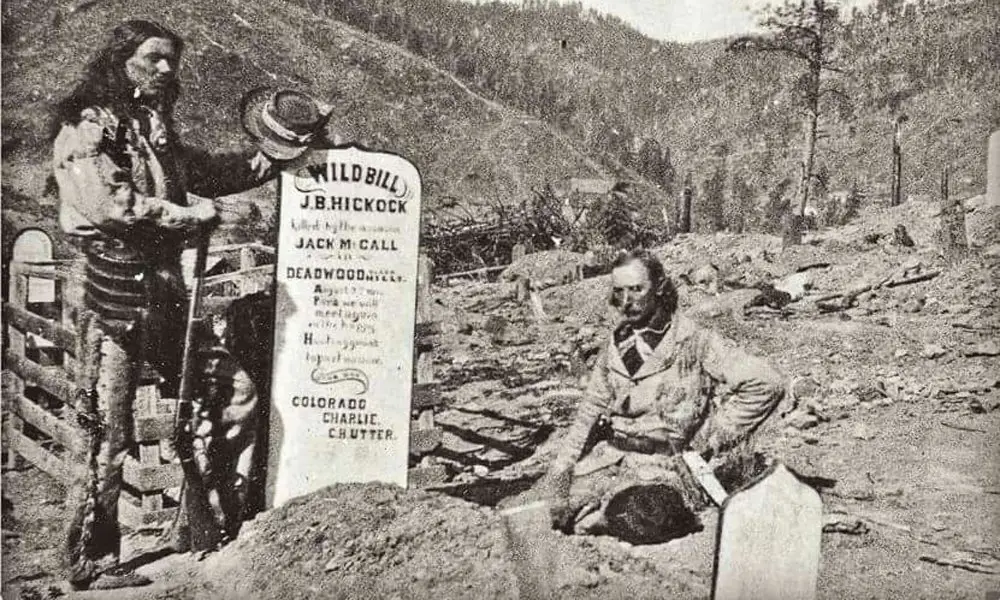
Public domain Charlie Utter's wagon train brought Wild Bill Hickok and Calamity Jane into the gulch. The city timeline says June; South Dakota Public Broadcasting says July. WyoHistory reports the pair riding in together in a June parade. Hickok had married Agnes Lake in Cheyenne that March, five months before his death, and left her to join the rush. He had only weeks to live.
Read more: James Butler "Wild Bill" Hickok, Martha "Calamity Jane" Canary, Charles H. "Colorado Charlie" Utter, The Gold Rush and the Founding of Deadwood
Sources: Timeline of Deadwood, South Dakota, City of Deadwood Historic Preservation Office, Wild Bill Hickok in Deadwood, South Dakota Public Broadcasting, Calamity Jane: Heroine of the West or Ordinary Woman?, WyoHistory.org, Martha "Calamity Jane" Canary brochure, City of Deadwood Archives, Wild Bill Hickok, Wikipedia
Fall 1876Sign or starve
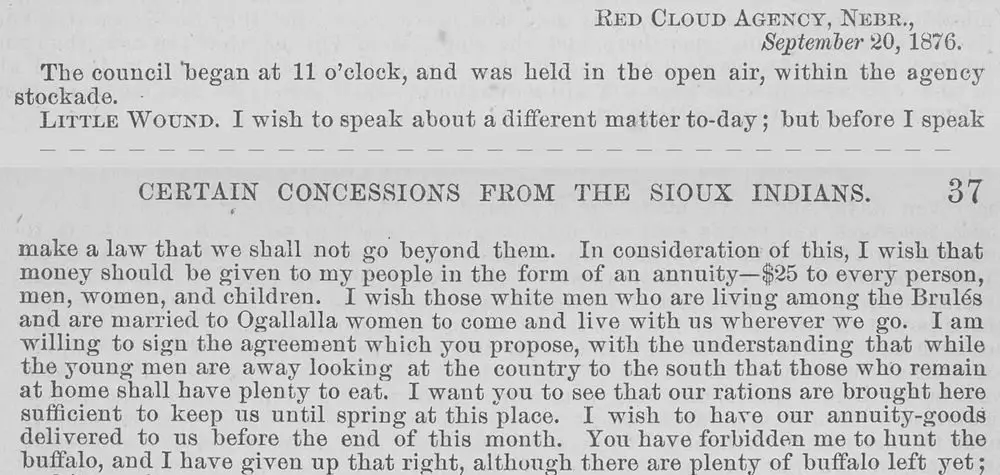
U.S. Commission to Treat with the Sioux, public domain Congress cut off subsistence funding to the Sioux until they gave up the Hills, and a commission led by George Manypenny presented a prepared agreement. The Park Service says the leaders who signed that October were forced. The Supreme Court later found only about ten percent of adult Sioux men had signed, far short of the three-fourths the 1868 treaty required.
Read more: Paha Sapa: The Lakota Homeland
Sources: United States v. Sioux Nation of Indians, 448 U.S. 371 (1980), Legal Information Institute, President Ulysses S. Grant and Federal Indian Policy, National Park Service, Black Hills, Sacred Land Film Project
Early Deadwood
A camp becomes a town, and burns, and rebuilds.
August 1876Bullock and Star open for business
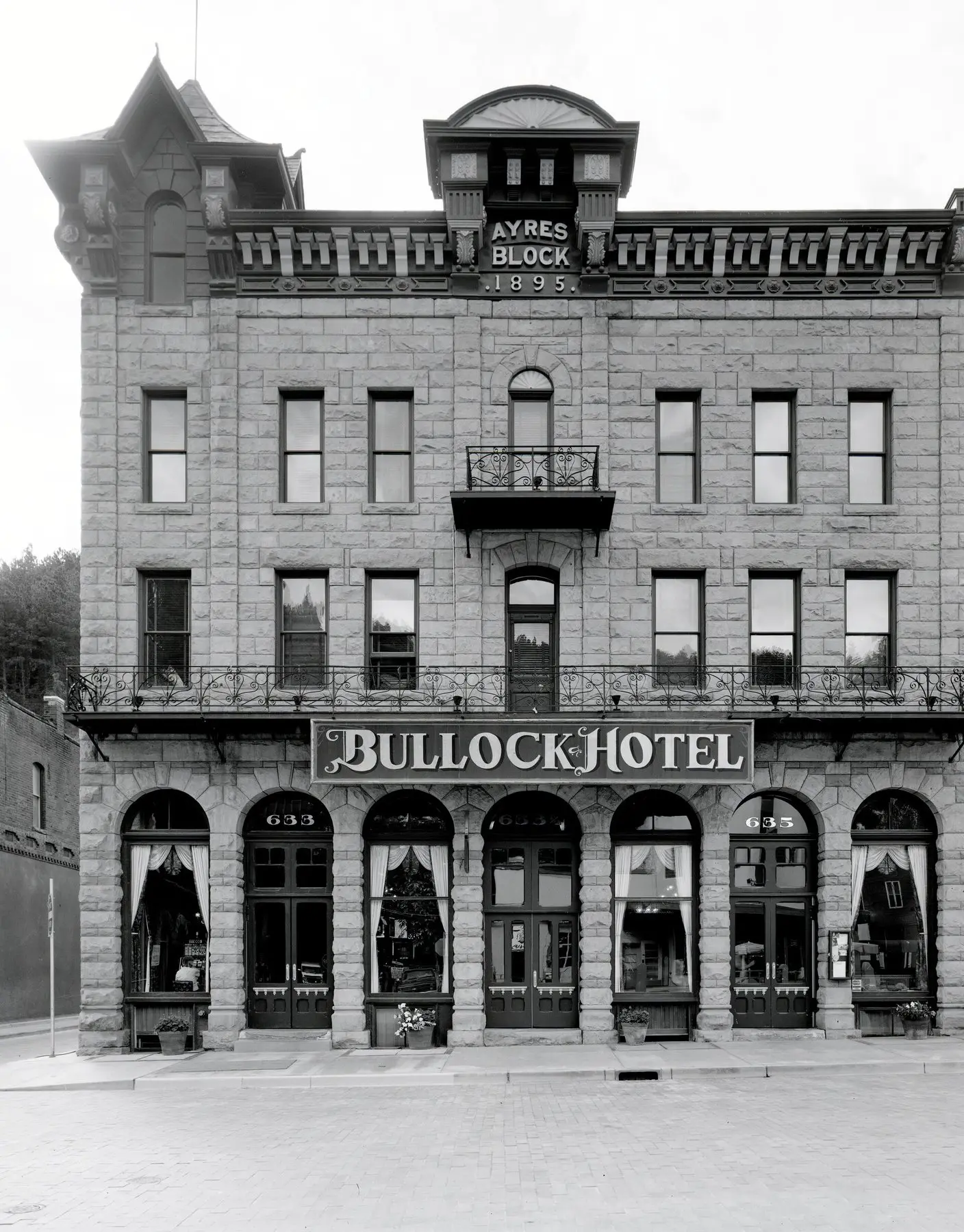
Carol M. Highsmith, public domain Seth Bullock and Sol Star reached the gulch from Montana with a load of hardware and set up on the corner where the Bullock Hotel now stands. The date depends on whom you ask: the city brochure says August 1, and Bullock's own letter is cited for August 3. Either way, they arrived within a day of Hickok's death.
Read more: Seth Bullock, Sol Star, The Gold Rush and the Founding of Deadwood
Sources: Seth Bullock brochure, City of Deadwood Archives, Seth Bullock, Wikipedia, Sol Star, Wikipedia, Deadwood's Bullock Hotel continues to stand as monument, Mitchell Republic
August 2, 1876Wild Bill is shot
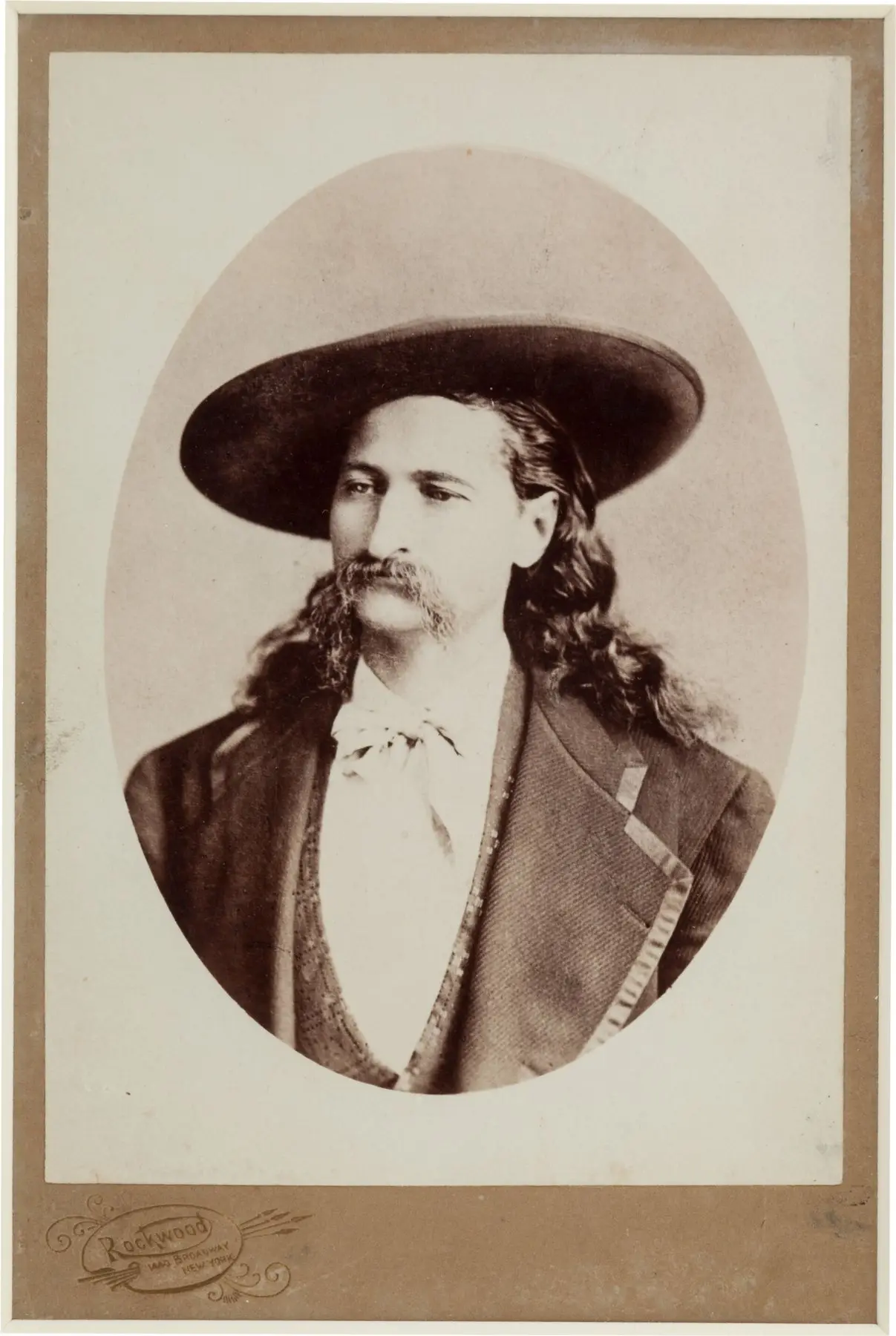
George G. Rockwood, public domain Jack McCall walked into Nuttal and Mann's No. 10 Saloon and shot Hickok in the back of the head during a poker game. He was buried the next day in the Ingleside camp cemetery. His last hand is remembered as aces and eights, the dead man's hand, yet the City of Deadwood's own archives call its true makeup an unresolved mystery.
Read more: James Butler "Wild Bill" Hickok, John "Jack" McCall, The Gold Rush and the Founding of Deadwood, Mount Moriah Cemetery
Sources: James Butler "Wild Bill" Hickok brochure, City of Deadwood Archives, Timeline of Deadwood, South Dakota, City of Deadwood Historic Preservation Office, Deadwood commemorates 150th anniversary of Wild Bill Hickok's death, KOTA
August 3, 1876A miners' court lets McCall go
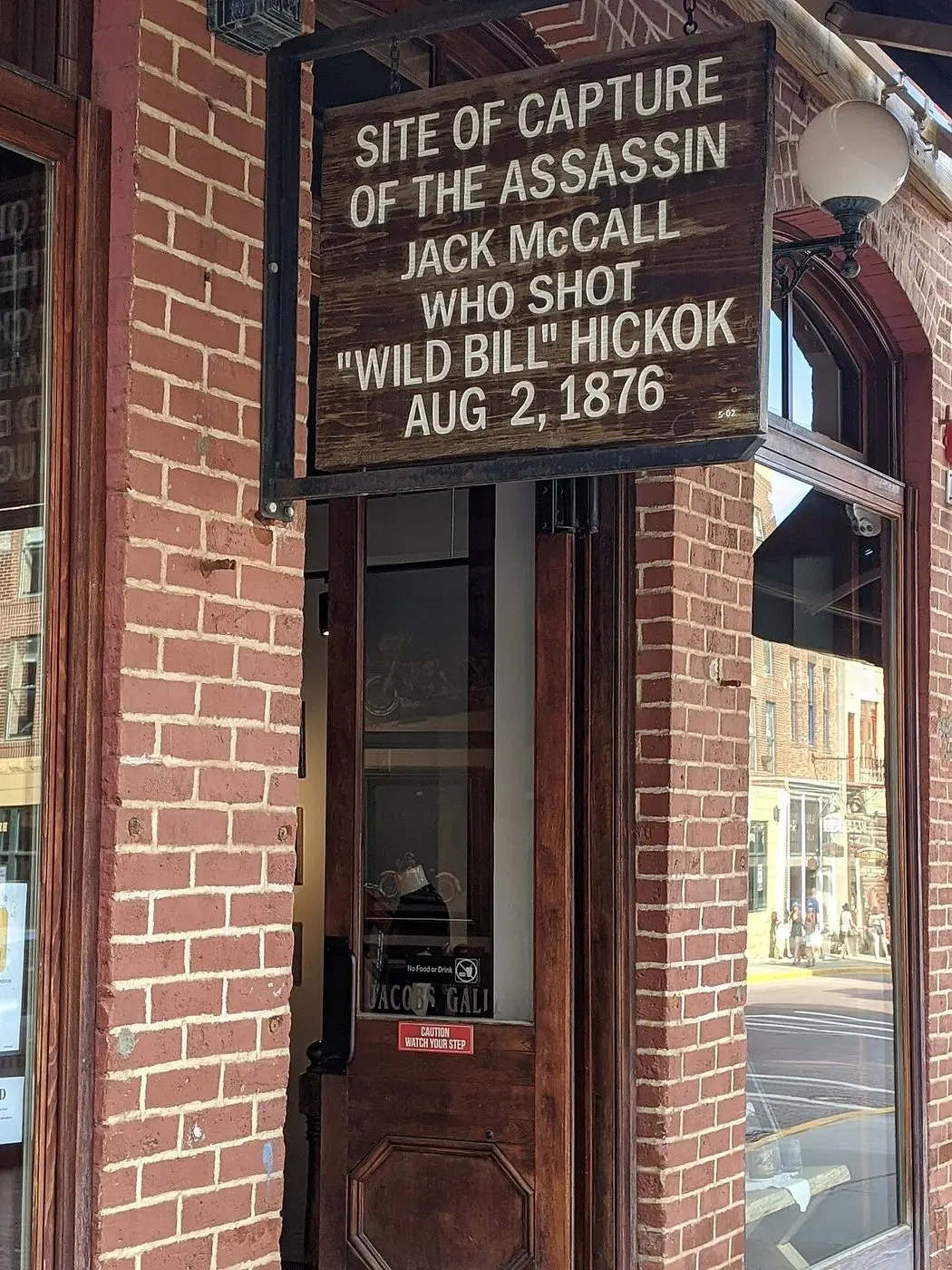
Justin M. Skiba, CC BY-SA 4.0 An improvised court of local men tried Jack McCall the day after the shooting and acquitted him in about two hours. He claimed Hickok had killed his brother, a story the accounts offer no independent support for. Rumors of bribery followed the verdict. The Chamber of Commerce's history says the outcome persuaded residents that the camp needed real law and order.
Read more: John "Jack" McCall, James Butler "Wild Bill" Hickok, The Gold Rush and the Founding of Deadwood
Sources: John "Jack" McCall Trials: 1876, Encyclopedia.com, Jack McCall, Wikipedia, Infamous Deadwood: Sheriff Seth Bullock, Deadwood Chamber of Commerce
August 18, 1876Deadwood's first mayor
AI-generated illustration, not a historical photo. Merchant E.B. Farnum won the camp's first mayoral election with 672 of 1,139 votes. His government had no legal standing, since the camp sat on reservation land, but it still acted like one: a pest house for smallpox, street cleaning, a fire department and a school by year's end. On December 1 a new telegraph line let him exchange messages with Cheyenne's mayor.
Read more: Ethan Bennett "E.B." Farnum, The Gold Rush and the Founding of Deadwood
Sources: Deadwood's first mayor, Black Hills Pioneer, E. B. Farnum, Wikipedia, Timeline of Deadwood, South Dakota, City of Deadwood Historic Preservation Office
August 20, 1876Death on the Crook City road
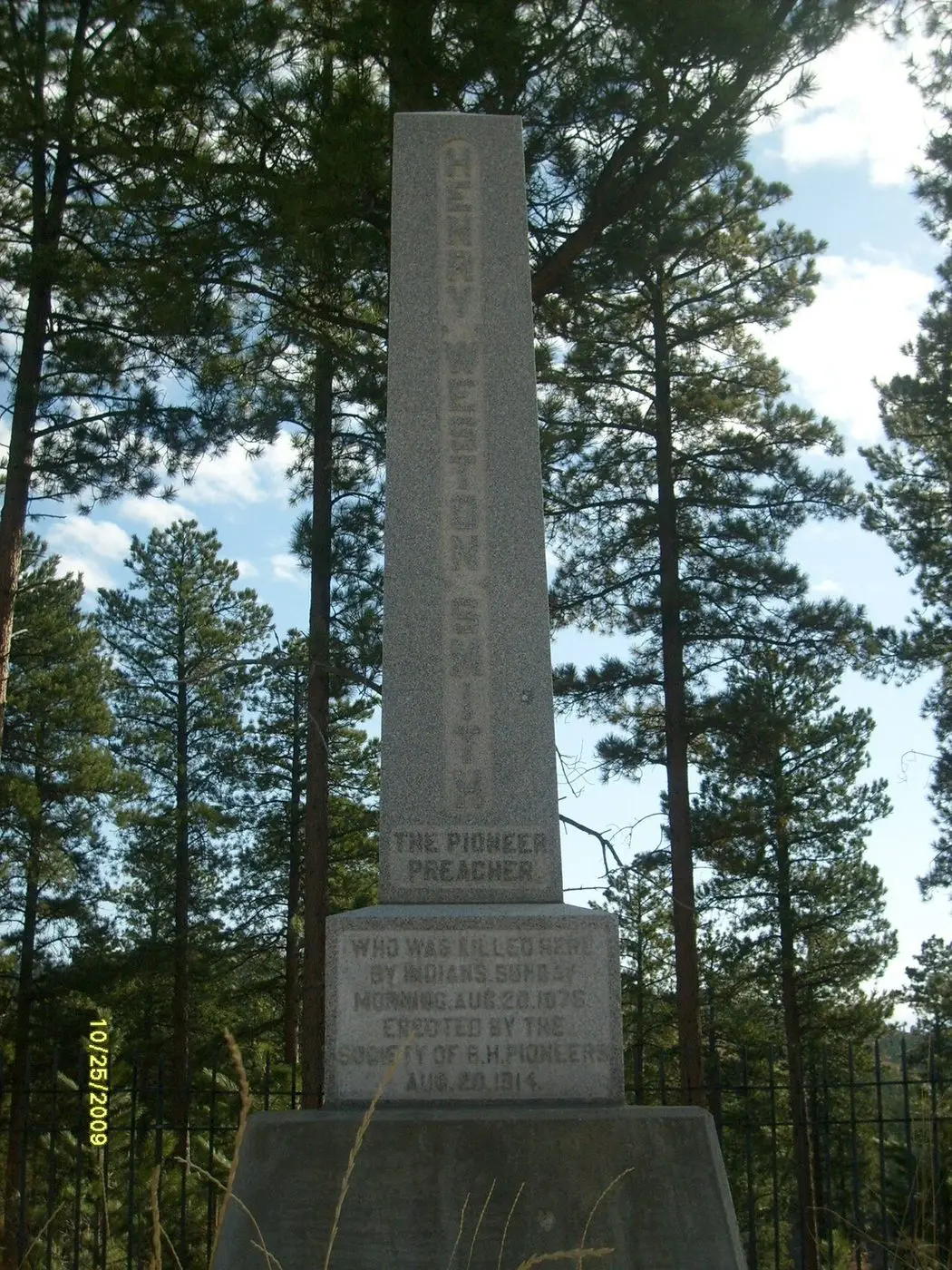
Louisvillejg, CC BY-SA 3.0 Henry Weston Smith, a Methodist preacher who had reached the camp in May, held Sunday service, left a note saying he would be back by three, and set off on foot to preach in Crook City. He was found shot dead on the road. His killer was never established: United Methodist archives say it may have been a lawless white man or a Sioux man.
Read more: Henry Weston "Preacher" Smith, Mount Moriah Cemetery
Sources: Deadwood Cluster, General Commission on Archives and History, United Methodist Church, Pioneer preacher remembered in Deadwood, KUNC, Timeline of Deadwood, South Dakota, City of Deadwood Historic Preservation Office
By 1877Deadwood's Chinese community
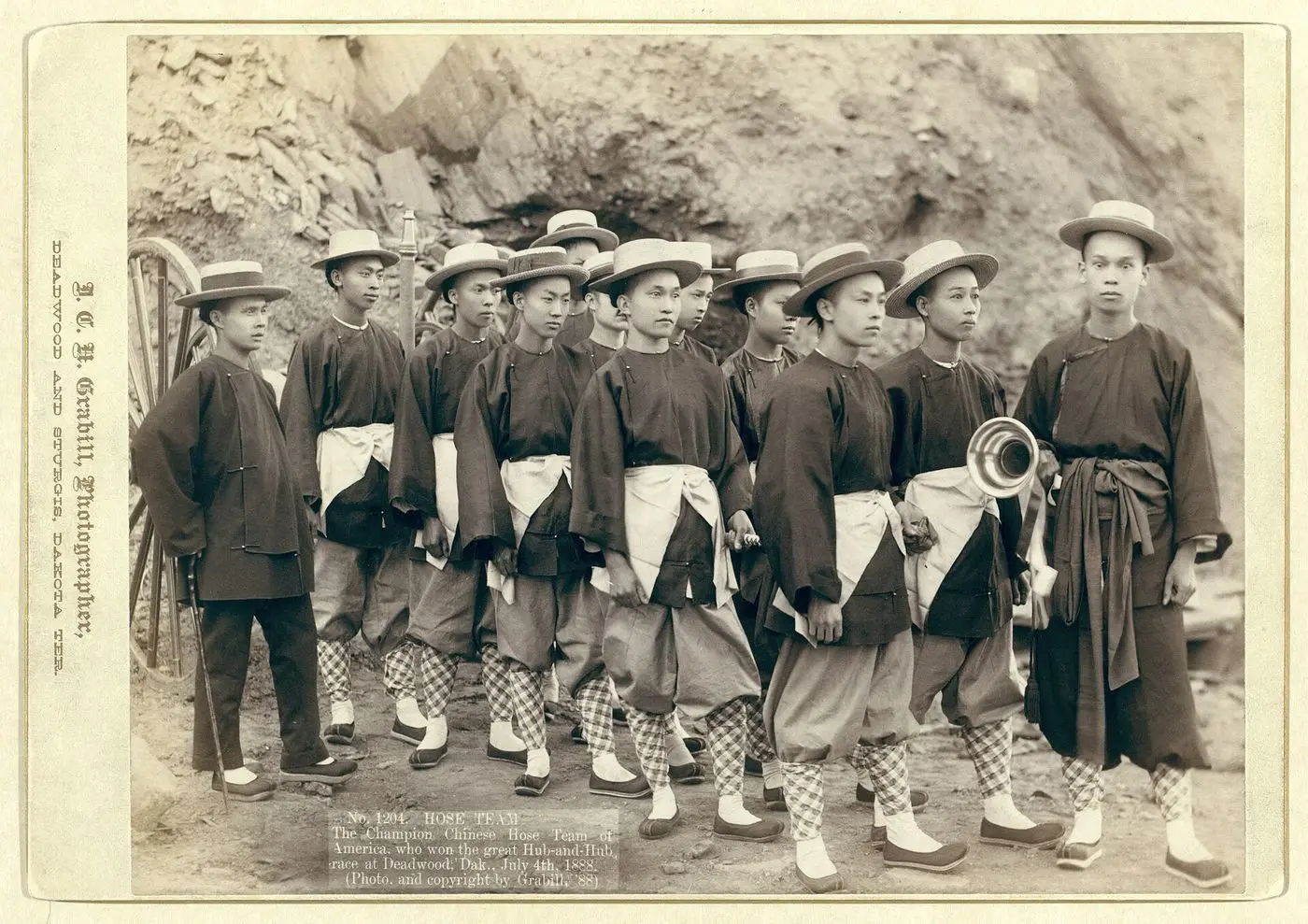
John C. H. Grabill, public domain Newspaper notices record a steady stream of Chinese arrivals bound for the Hills from 1877, and a Chinatown took shape on lower Main Street. Census counts show about 220 Chinese residents in Lawrence County in 1880, though local accounts run as high as 500. They owned shops and restaurants, worked as physicians and cooks, reworked mine tailings, and lived under the 1882 Exclusion Act.
Read more: Fire, Flood and Rebuilding
Sources: The Archaeology of Deadwood's Chinatown: A Prologue, South Dakota History 33:4
February 28, 1877Congress takes the Black Hills
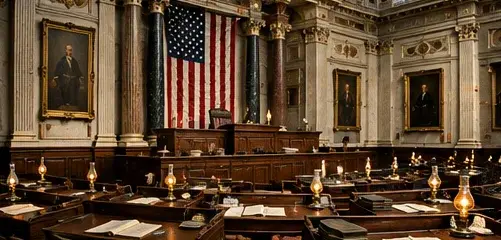
AI-generated illustration, not a historical photo. Congress enacted the agreement into law, effectively abrogating the 1868 treaty. Mario Gonzalez, general counsel for the Oglala Sioux Tribe, has said the tribes have held since 1877 that the seizure was illegal. The city timeline gives February 22; the Supreme Court's date is February 28. Only then could Lawrence County be formally organized, that April, with Seth Bullock as its first appointed sheriff.
Read more: Seth Bullock, Paha Sapa: The Lakota Homeland
Sources: United States v. Sioux Nation of Indians, 448 U.S. 371 (1980), Legal Information Institute, Black Hills background, PBS NewsHour, Timeline of Deadwood, South Dakota, City of Deadwood Historic Preservation Office, Dakota Images: Seth Bullock, South Dakota History 20:1
March 1, 1877McCall hangs at Yankton
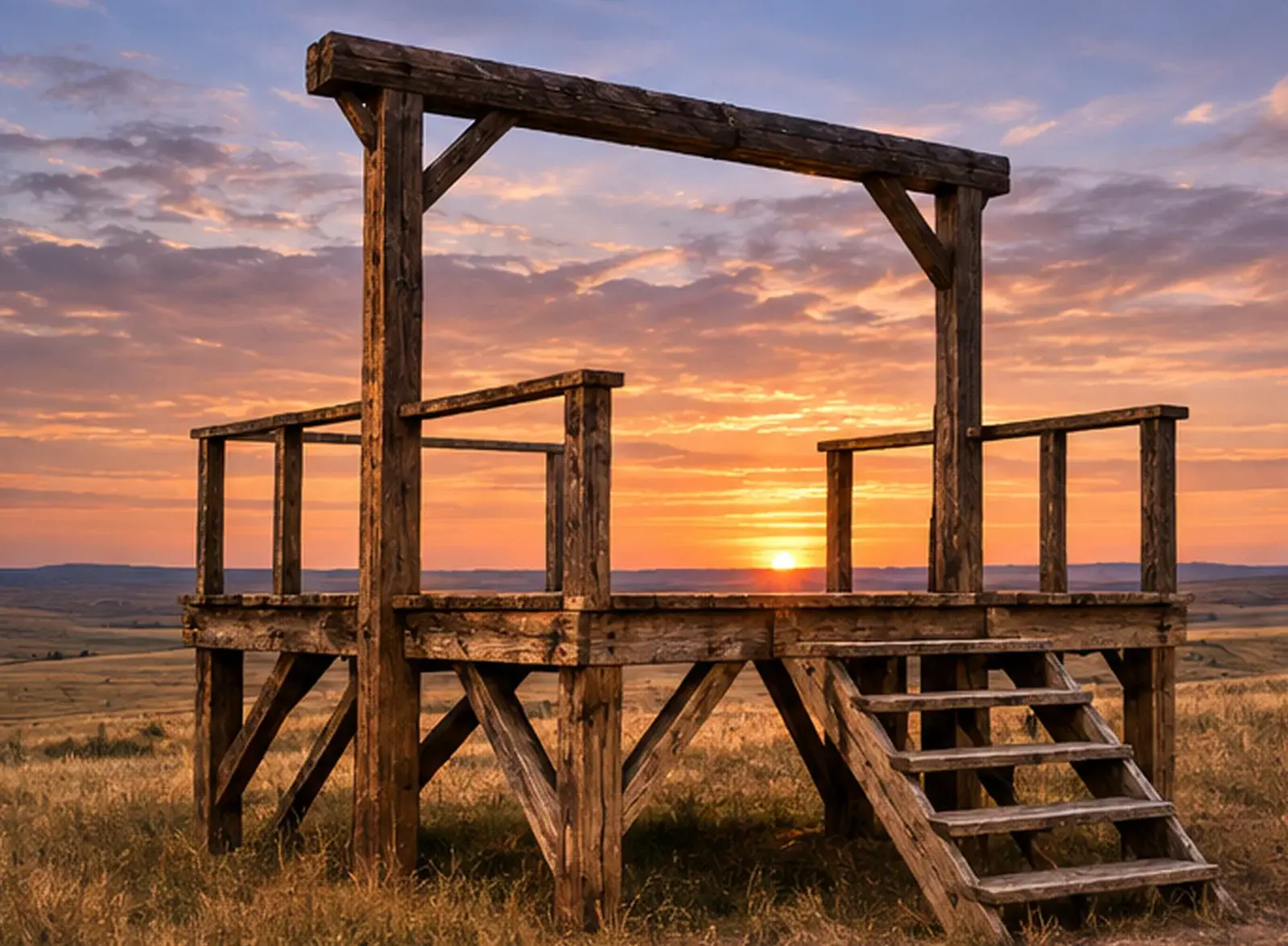
AI-generated illustration, not a historical photo. A federal court ruled the Deadwood acquittal void, because the camp had no lawful court on what was then reservation land, and tried Jack McCall again in Yankton. He had been arrested in Laramie in August 1876 and was convicted that December. He was hanged on March 1, 1877, the first federal execution in Dakota Territory. His burial place is now unknown.
Read more: John "Jack" McCall, The Gold Rush and the Founding of Deadwood
Sources: John "Jack" McCall Trials: 1876, Encyclopedia.com, Jack McCall's Execution, Prairie Public, Jack McCall, Wikipedia
April 7, 1877The Gem opens
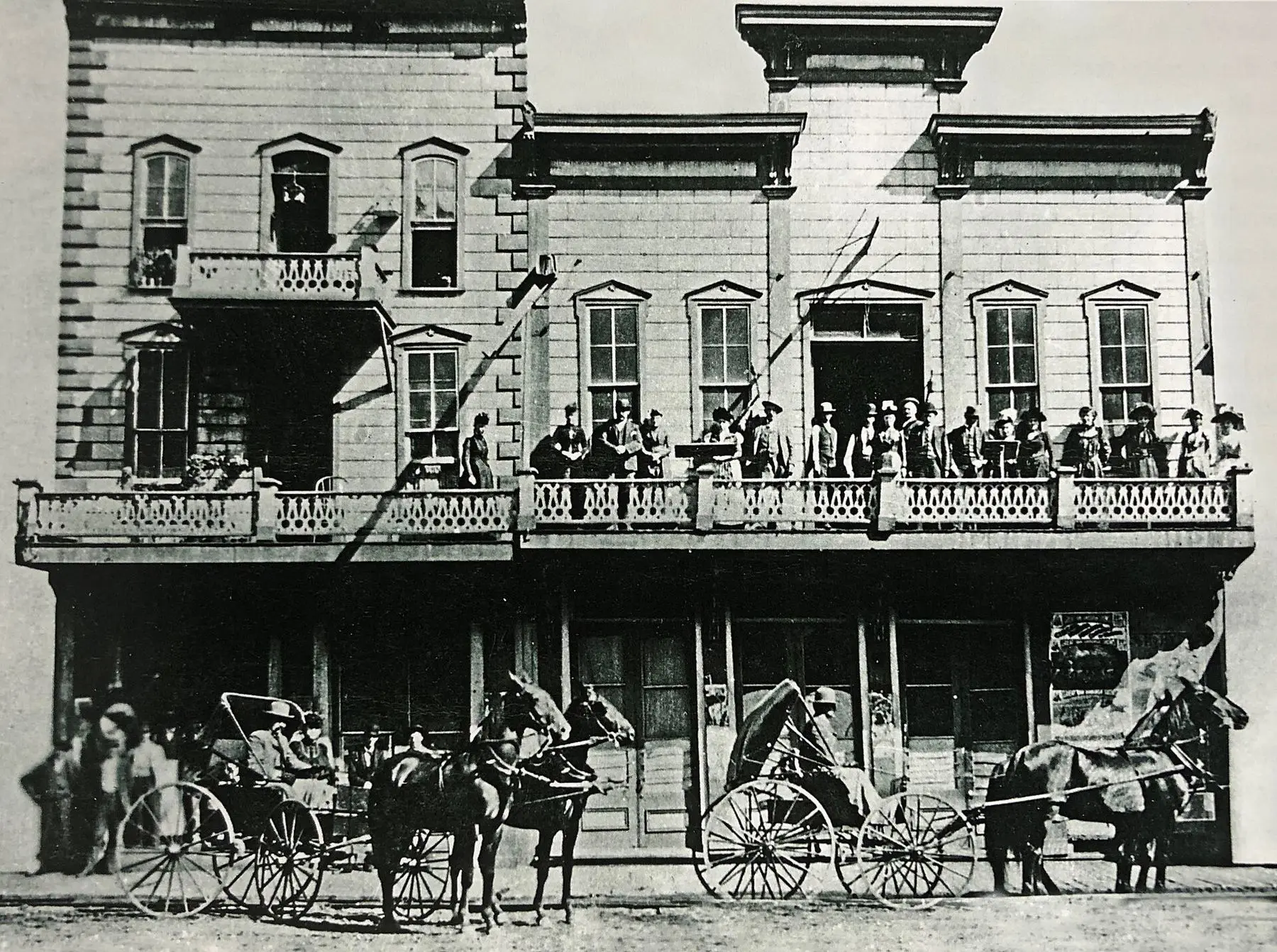
Public domain Al Swearengen opened the Gem Variety Theater, a saloon, stage and brothel at Wall and Main. The Chamber of Commerce dates it to 1876, while other accounts say 1877. Records describe him beating his wife, and women recruited with false promises of honest work. The Gem burned in 1879 and for the last time on December 19, 1899. Swearengen, by then short of money, left town.
Read more: Ellis Albert "Al" Swearengen, The Gold Rush and the Founding of Deadwood
Sources: Gem Theater (Deadwood, South Dakota), Wikipedia, Deadwood's Al Swearingen, HistoryNet, Infamous Deadwood: Al Swearengen, Deadwood Chamber of Commerce, Timeline of Deadwood, South Dakota, City of Deadwood Historic Preservation Office
September 5, 1877Crazy Horse dies at Fort Robinson
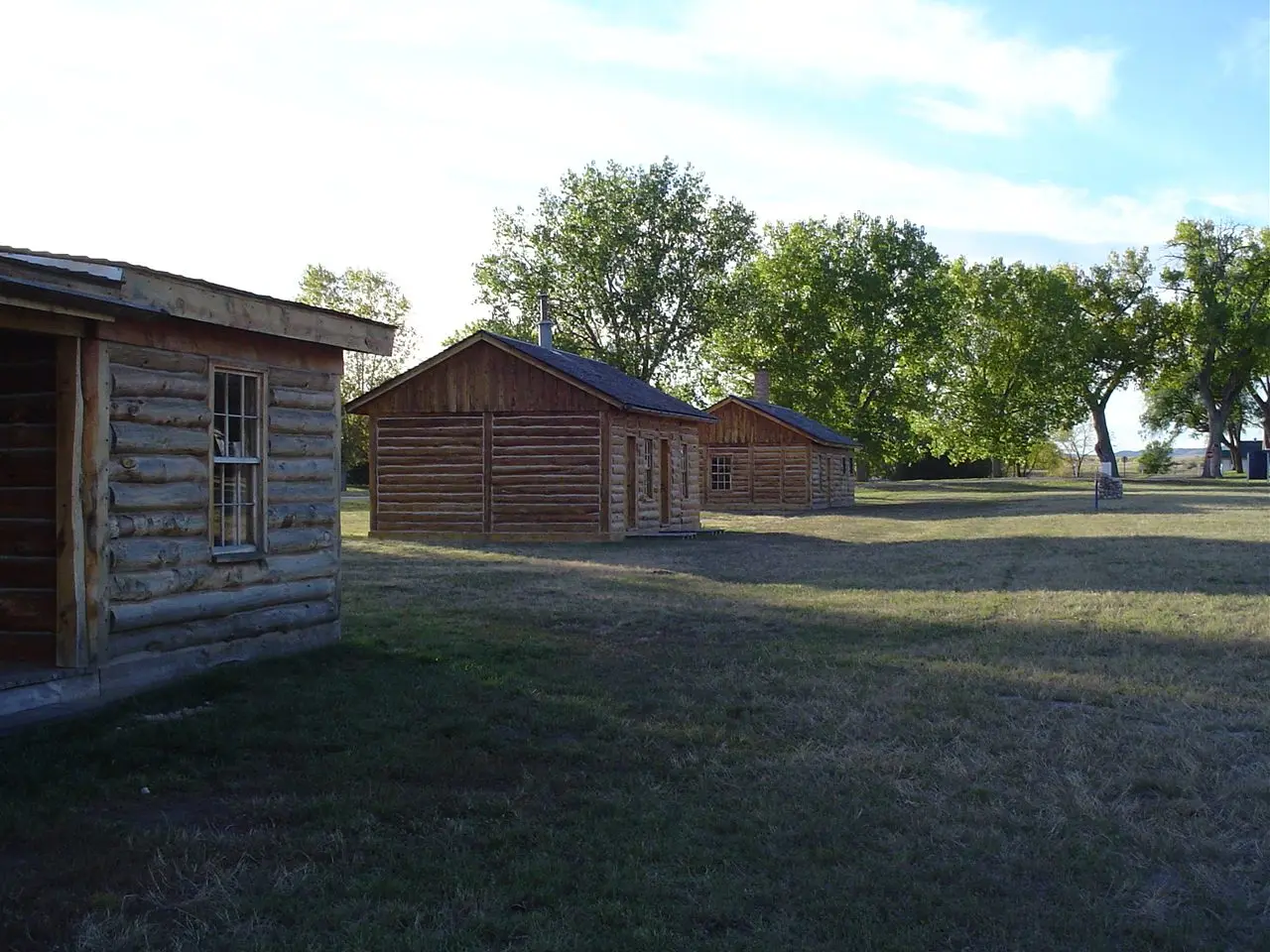
Slothus, CC BY-SA 3.0 Crazy Horse, who had surrendered that May, was bayoneted by a soldier during an attempt to imprison him at Fort Robinson, Nebraska, and died hours later. Rumors spread by rival chiefs and believed by junior officers helped bring on the arrest. Witness accounts differ on what happened in the final struggle, and no authenticated photograph of him is known.
Read more: Crazy Horse, Paha Sapa: The Lakota Homeland
Sources: Crazy Horse, Encyclopedia of the Great Plains, The Death of Crazy Horse, Oxford University Press blog, Crazy Horse, Wikipedia, Fort Laramie in 1876, National Park Service
1878A cemetery on the hill
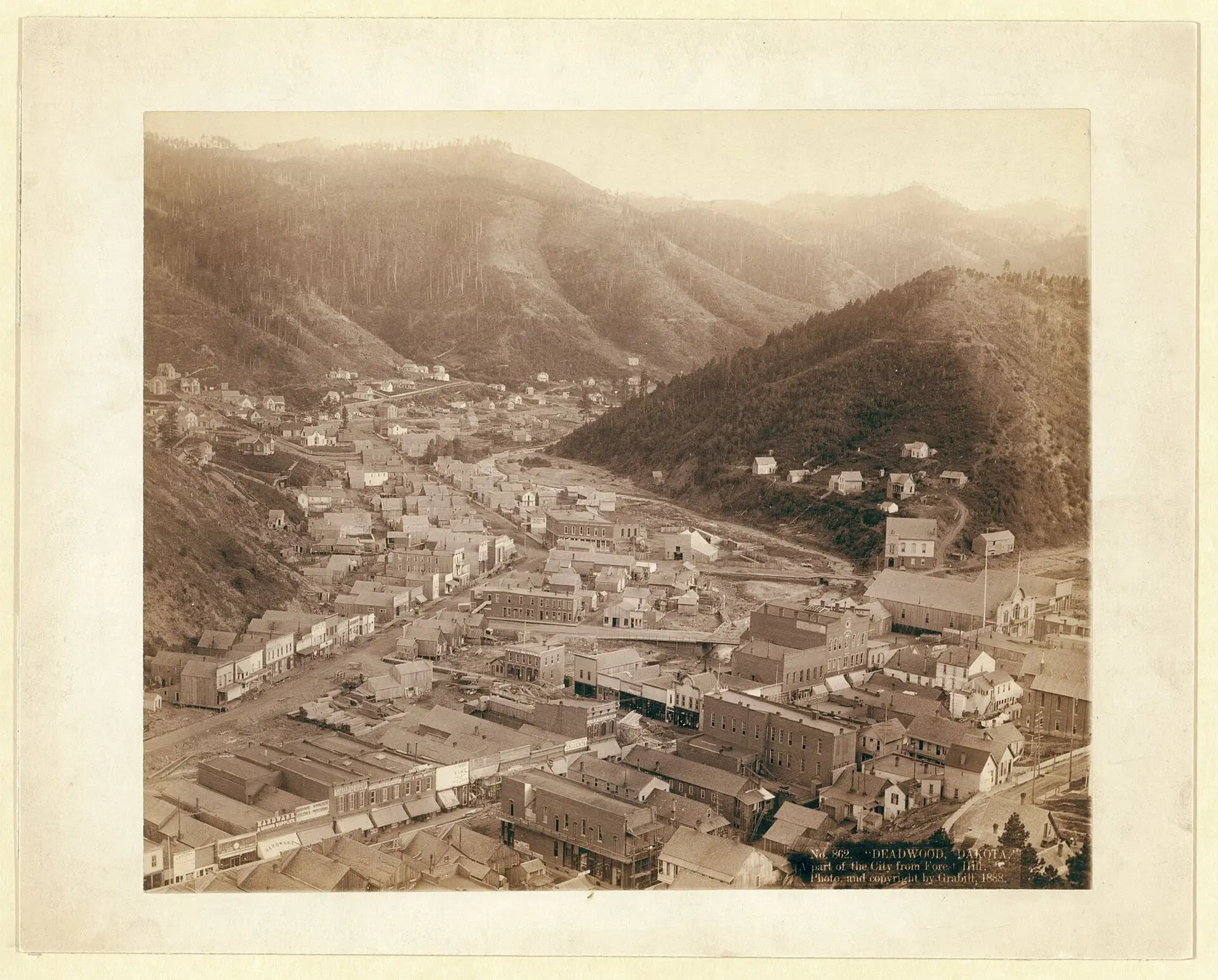
John Grabill, public domain Lawrence County bought 4.6 acres above the gulch for a new cemetery. The first of 3,627 recorded burials, James Delong, took place on June 1, 1878. Remains from Deadwood's first cemetery at Ingleside were moved up over the following years, though not all. Human remains from that older ground turned up in the Presidential Neighborhood in 2007, and a second set six years later.
Read more: Mount Moriah Cemetery
Sources: Mt. Moriah Cemetery brochure, City of Deadwood Archives, Timeline of Deadwood, South Dakota, City of Deadwood Historic Preservation Office, Mount Moriah Cemetery, City of Deadwood Parks and Recreation
1876 or 1878Calamity Jane and the smallpox
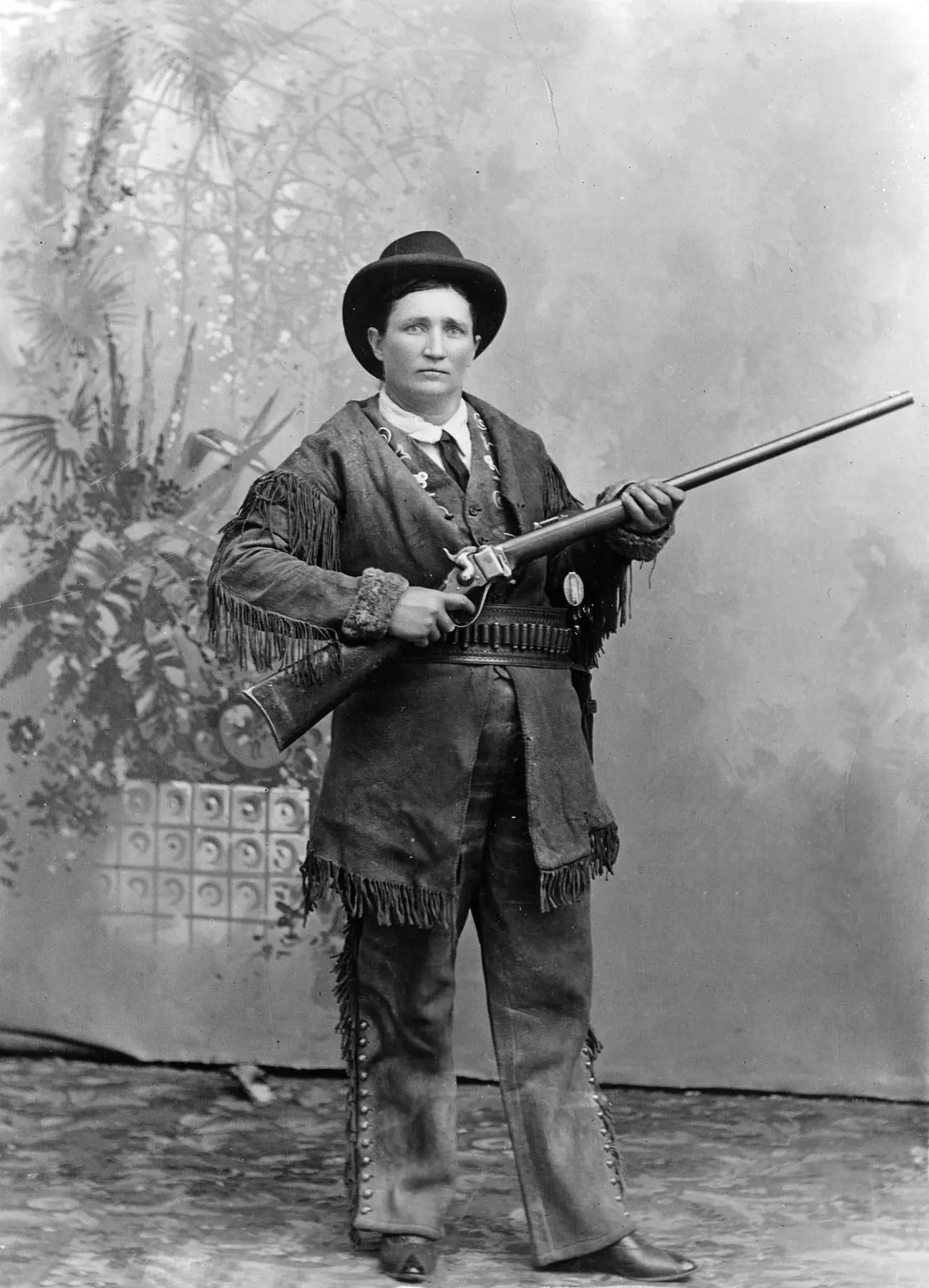
C.E. Finn, Livingston, Montana, public domain Sources disagree about when smallpox tested the camp. E.B. Farnum's pest house dates to 1876, while the city's brochure places Calamity Jane's nursing in an 1878 epidemic. The city credits her with helping the sick without concern for her own well-being. The Encyclopedia of the Great Plains also describes her caring for sick people, even as her own life unraveled through heavy drinking.
Read more: Martha "Calamity Jane" Canary, Ethan Bennett "E.B." Farnum, Fire, Flood and Rebuilding
Sources: Martha "Calamity Jane" Canary brochure, City of Deadwood Archives, E. B. Farnum, Wikipedia, Calamity Jane, Encyclopedia of the Great Plains
August 1879Wild Bill moves uphill
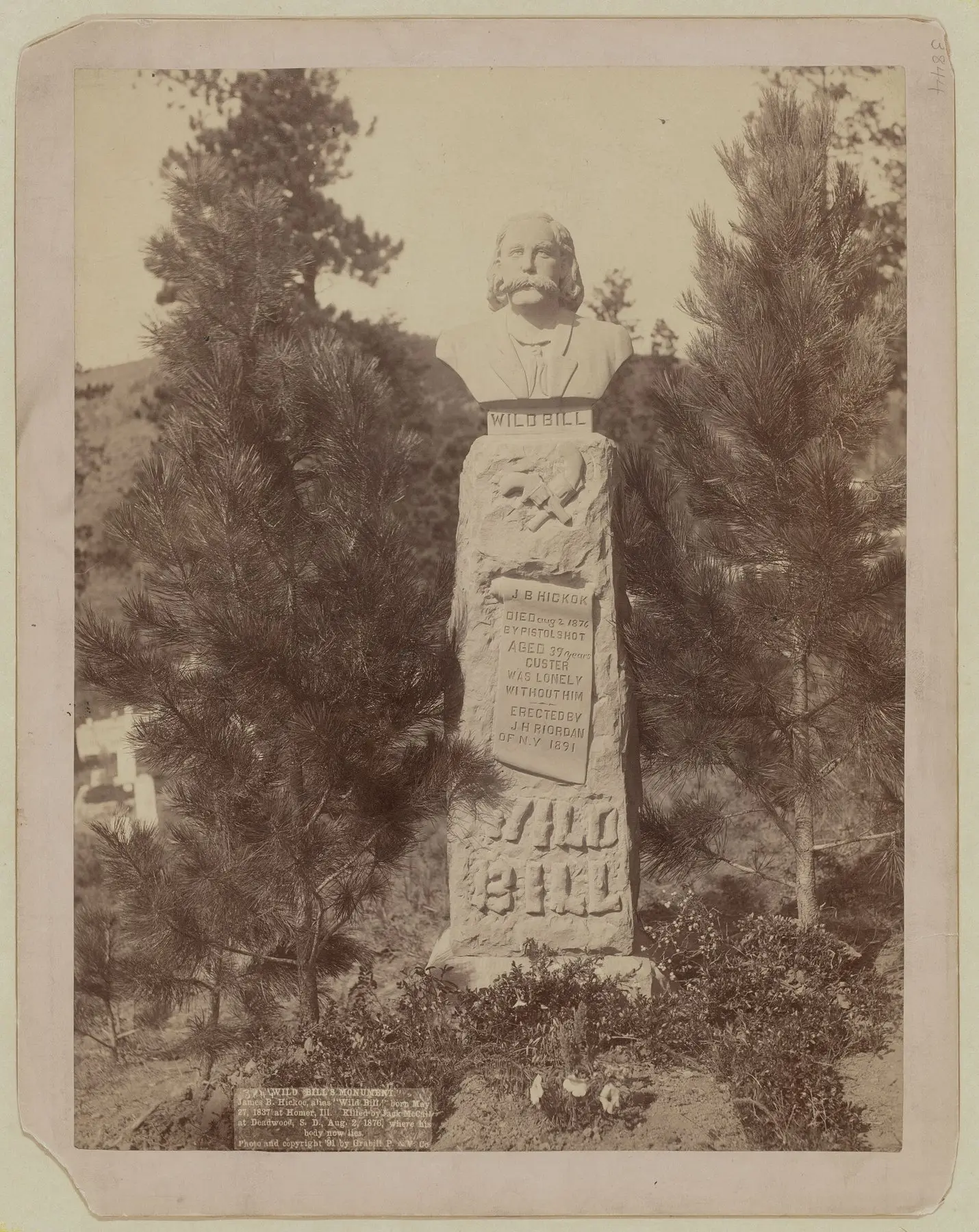
John Grabill, public domain Charlie Utter had Hickok's body moved from the first cemetery to Mount Moriah, into a plot with a cast-iron fence. Stories that the corpse had turned to stone are repeated in popular accounts. Souvenir hunters and vandals soon went to work on the grave. Citizens commissioned a new marker in 1890, and a bronze likeness of it was placed there in 2002.
Read more: James Butler "Wild Bill" Hickok, Charles H. "Colorado Charlie" Utter, Mount Moriah Cemetery
Sources: Timeline of Deadwood, South Dakota, City of Deadwood Historic Preservation Office, James Butler "Wild Bill" Hickok brochure, City of Deadwood Archives, Charlie Utter, Wikipedia, Wild Bill Hickok in Deadwood, South Dakota Public Broadcasting, Wild Bill Hickok, Wikipedia
September 26, 1879The Great Fire
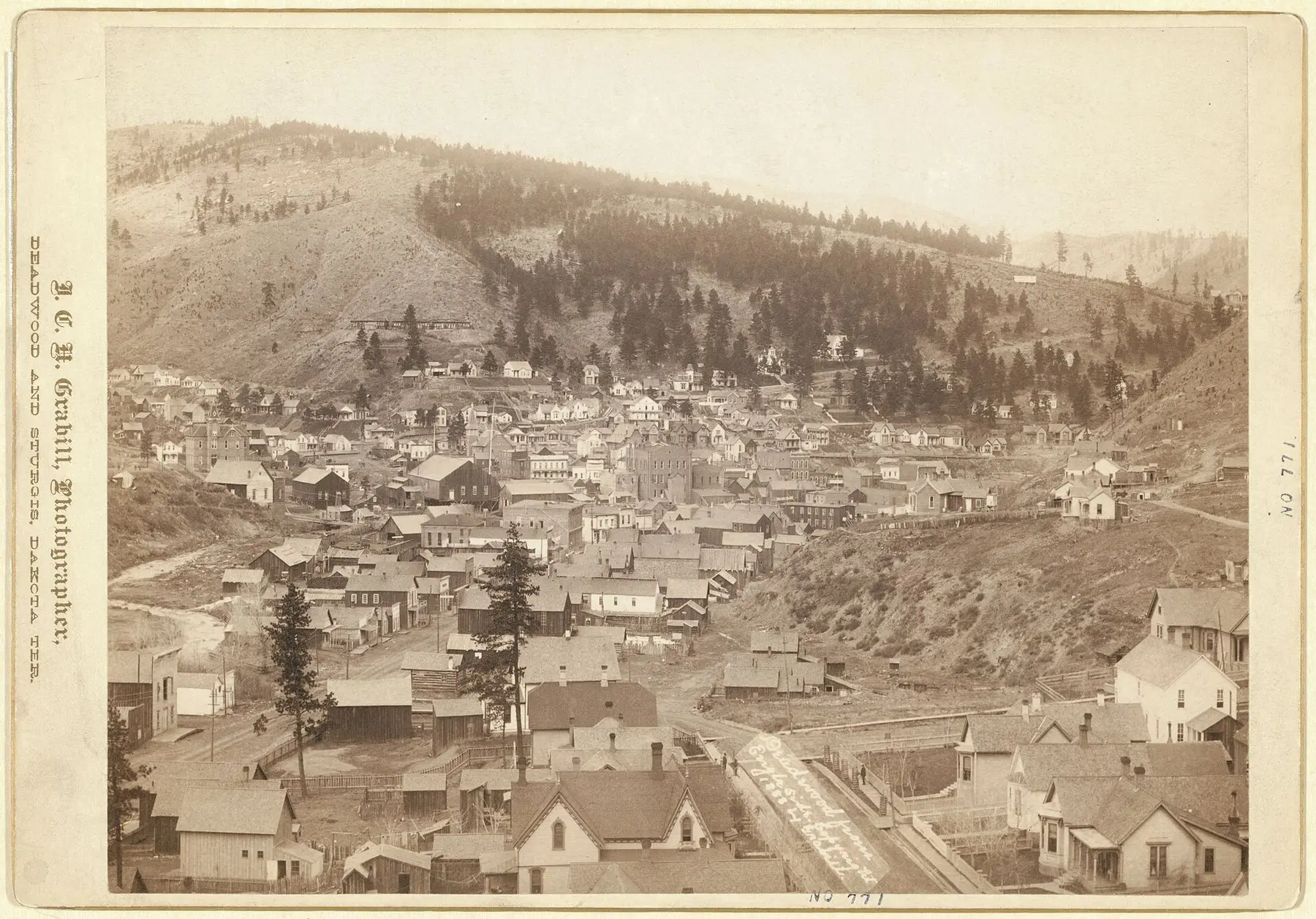
John Grabill, public domain A lamp knocked over in the Empire Bakery on Sherman Street started the blaze in the small hours; accounts say 2:30 or 3:30 a.m. Fire reached eight kegs of powder at Jensen and Bliss Hardware and blew burning debris across town. More than 300 buildings burned, leaving nearly 2,000 people homeless. Those who stayed rebuilt in brick and stone, the Deadwood still standing today.
Read more: Ellis Albert "Al" Swearengen, William Emery "W.E." Adams, Seth Bullock, Fire, Flood and Rebuilding
Sources: Deadwood Fire, Dakota Datebook, Prairie Public, The great fire of Deadwood, Black Hills Pioneer, Timeline of Deadwood, South Dakota, City of Deadwood Historic Preservation Office
The Mining Era
Homestake and the long industrial decades.
1877Hearst buys the Homestake
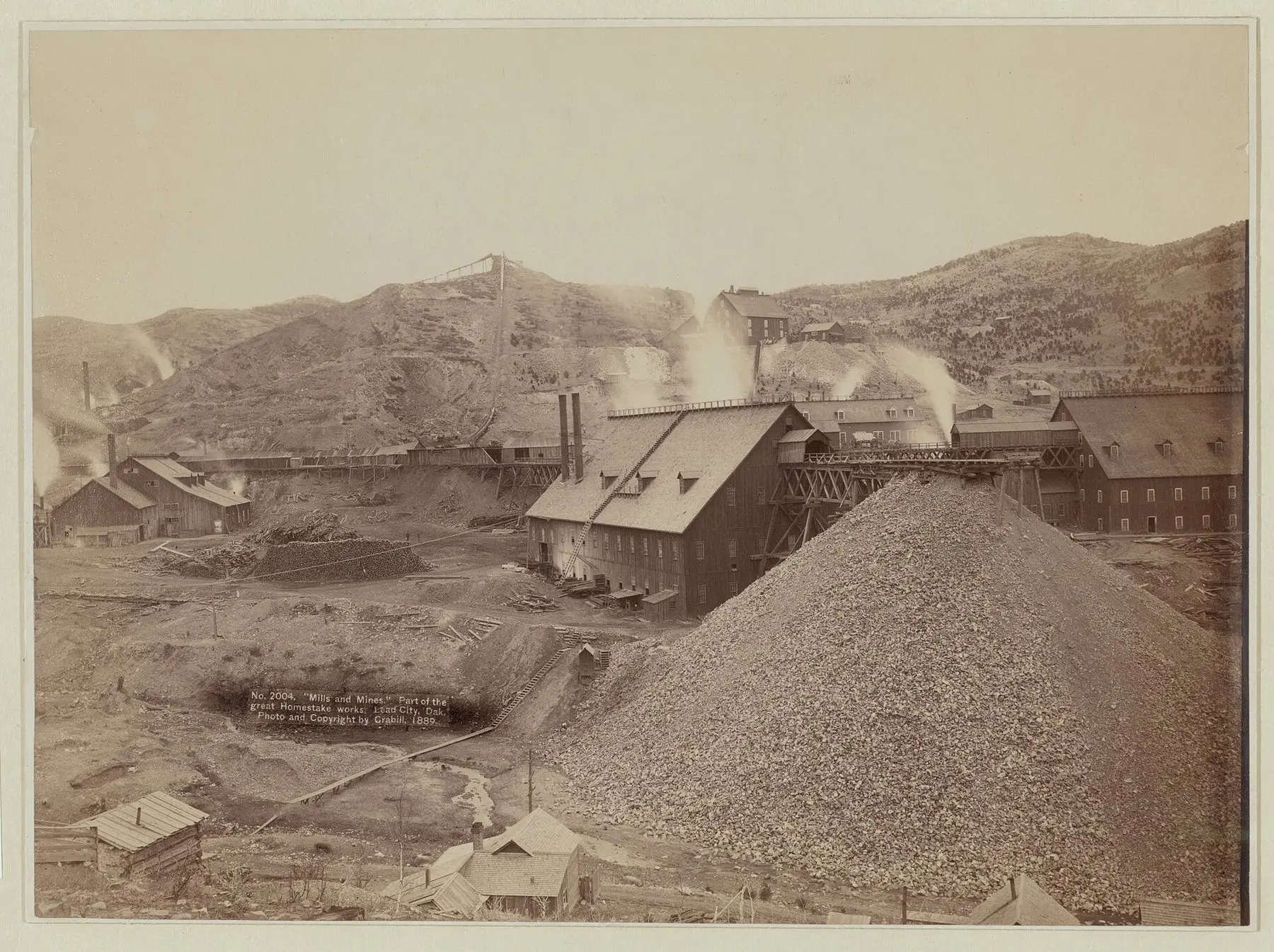
John Grabill, public domain Moses and Fred Manuel, with partners, had found the Homestake lode near present-day Lead in 1876. In 1877 a California syndicate of George Hearst, Lloyd Tevis and James Ben Ali Haggin bought the claims for $70,000, and Hearst reached the Hills that October. An 80-stamp mill began crushing ore the next July. It would run for more than a century.
Read more: The Homestake: Gold, Lead and a Company Town
Sources: Homestake Mine, Encyclopedia of the Great Plains, Homestake Mine (South Dakota), Wikipedia
May 1883The flood of 1883
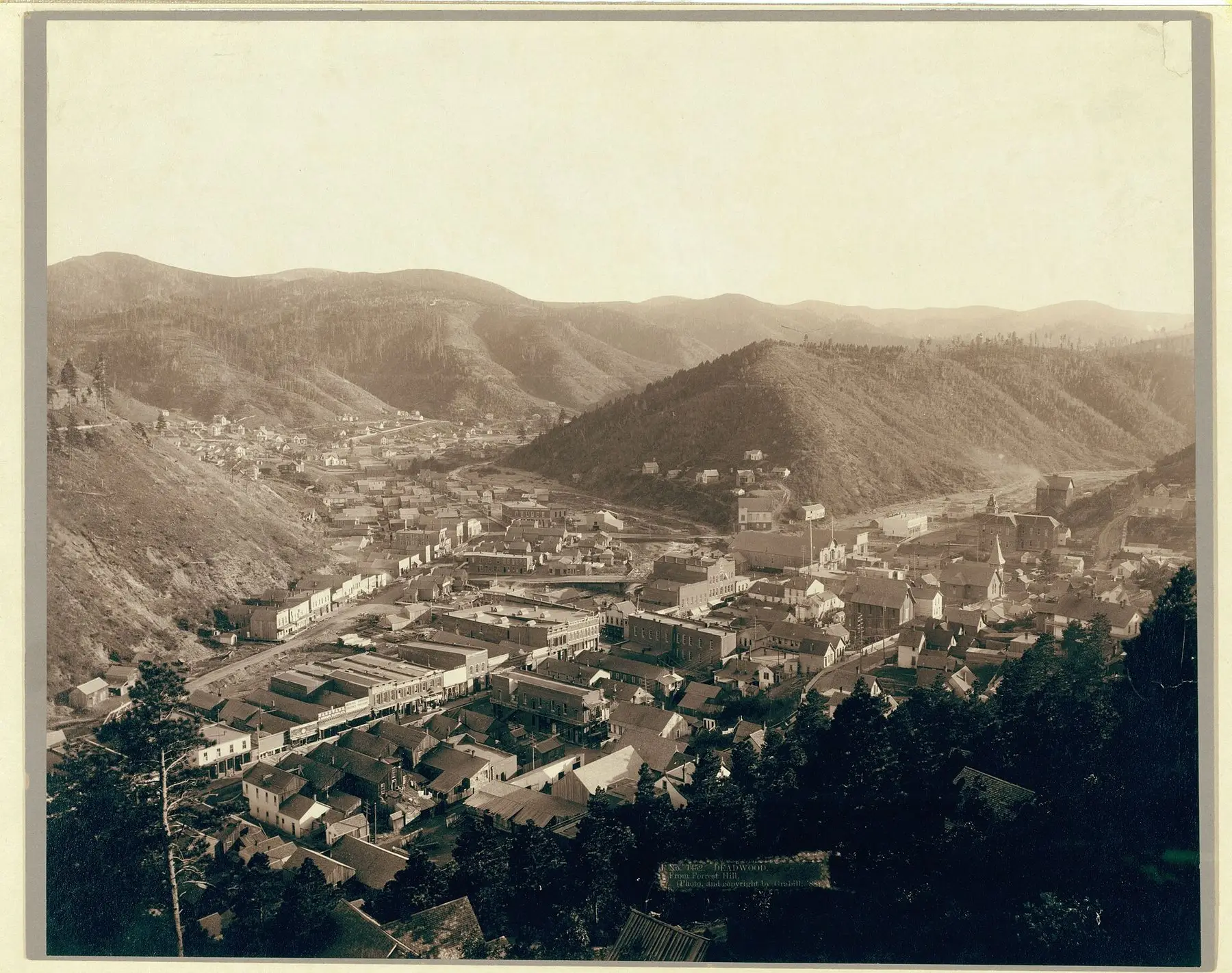
John Grabill, public domain Heavy rain on top of snowmelt sent extremely high water through the northern Hills. The National Park Service's landmark study records 150 buildings destroyed and three lives lost in Deadwood. The U.S. Geological Survey dates the flood to May 17, the city to May 18. Few of the wooden-front buildings from the earliest years survived this combination of fire and water.
Read more: Fire, Flood and Rebuilding
Sources: Deadwood Historic District, National Historic Landmark nomination, National Park Service, Black Hills Area Floods, 1877 to 1890, U.S. Geological Survey, Flood, Deadwood (picture 1), U.S. Geological Survey, Timeline of Deadwood, South Dakota, City of Deadwood Historic Preservation Office
December 28, 1890Railroad replaces the stagecoach
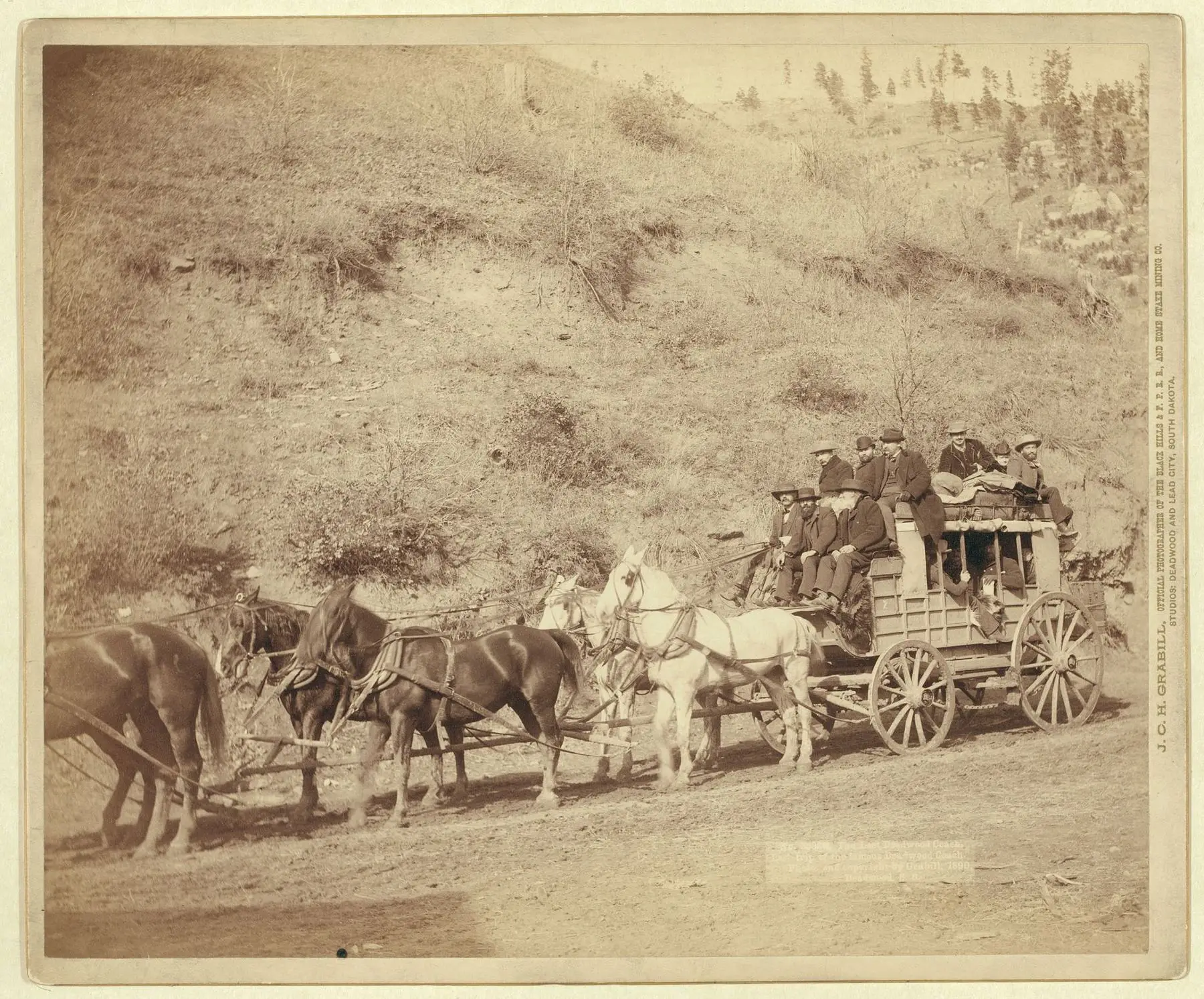
John Grabill, public domain The Fremont, Elkhorn and Missouri Valley Railroad reached Deadwood, connecting the town to the outside world by rail. Photographer John Grabill recorded what his caption calls the last Deadwood coach that same year. Reduction works for low-grade ore, built at the edge of town from 1887, helped keep the local economy going through the silver slump of 1893.
Read more: Fire, Flood and Rebuilding
Sources: Timeline of Deadwood, South Dakota, City of Deadwood Historic Preservation Office, Deadwood Historic District, National Historic Landmark nomination, National Park Service
August 26, 1892Roosevelt at City Hall
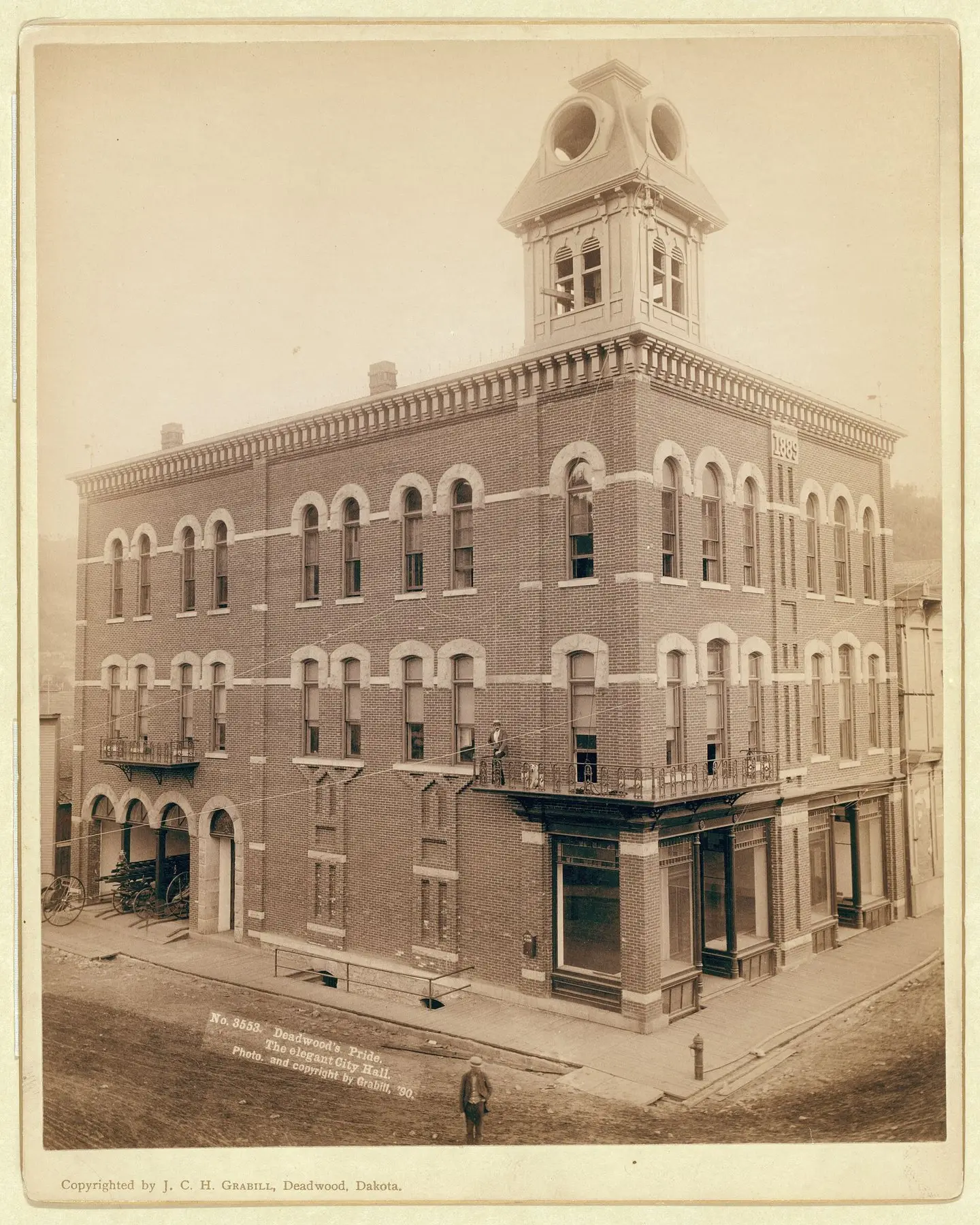
John Grabill, public domain Civil Service Commissioner Theodore Roosevelt gave an impromptu speech at Deadwood City Hall, which fire destroyed in 1952. The city's timeline and tower history say he and Seth Bullock first met on this trip, along the Belle Fourche River. The city's Bullock brochure, like other accounts, instead places the meeting in 1884, while Roosevelt was a deputy sheriff from Medora. The friendship shaped both men's later years.
Read more: Seth Bullock
Sources: Timeline of Deadwood, South Dakota, City of Deadwood Historic Preservation Office, Mt. Roosevelt Tower: A Brief History, City of Deadwood Archives, Seth Bullock brochure, City of Deadwood Archives
March 5, 1894Fire, and a hotel from the ashes
Carol M. Highsmith, public domain A fire destroyed the lower business district of Main Street, known as the Badlands. Historian David Wolff counts it among four fires that reshaped the town, with 1879, 1889 and 1987. It took Bullock and Star's hardware store, and they turned the surviving brick warehouse into the Bullock Hotel, which one source says opened in 1896. The silver slump of 1893 had already hit the town.
Read more: Seth Bullock, Sol Star, Fire, Flood and Rebuilding
Sources: Timeline of Deadwood, South Dakota, City of Deadwood Historic Preservation Office, South Dakota History explores Deadwood fires, South Dakota Historical Society Foundation, Deadwood's Bullock Hotel continues to stand as monument, Mitchell Republic, Bullock Hotel, Wikipedia, Deadwood Historic District, National Historic Landmark nomination, National Park Service
August 1, 1903Calamity Jane dies at Terry
C.E. Finn, Livingston, Montana, public domain Martha Canary died at the Calloway Hotel in Terry, near Deadwood, at about 47. She had returned to the Black Hills late in 1902 and had worked for a time at Dora DuFran's establishment in Belle Fourche. She was buried beside Hickok, reportedly her wish, though WyoHistory finds no close relationship documented between them beyond the 1876 parade.
Read more: Martha "Calamity Jane" Canary, Dora DuFran, James Butler "Wild Bill" Hickok, Mount Moriah Cemetery
Sources: Martha "Calamity Jane" Canary brochure, City of Deadwood Archives, Calamity Jane: Heroine of the West or Ordinary Woman?, WyoHistory.org, Calamity Jane, Encyclopedia of the Great Plains, Dora DuFran, Liverpool Footprint
November 24, 1909 to January 8, 1910The Homestake lockout
John Grabill, public domain When the Western Federation of Miners pushed to organize the mine, Superintendent Thomas Grier locked out the workforce on November 24. Men could return only by signing a pledge not to join a union, and Homestake stayed non-union until 1966. Free medical care, an aid fund and bonuses followed. South Dakota Public Broadcasting calls it 54 days, though its own dates run about 45.
Read more: The Homestake: Gold, Lead and a Company Town
Sources: The Homestake Mining Company Lockout, South Dakota Public Broadcasting
July 4, 1919Bullock's last project
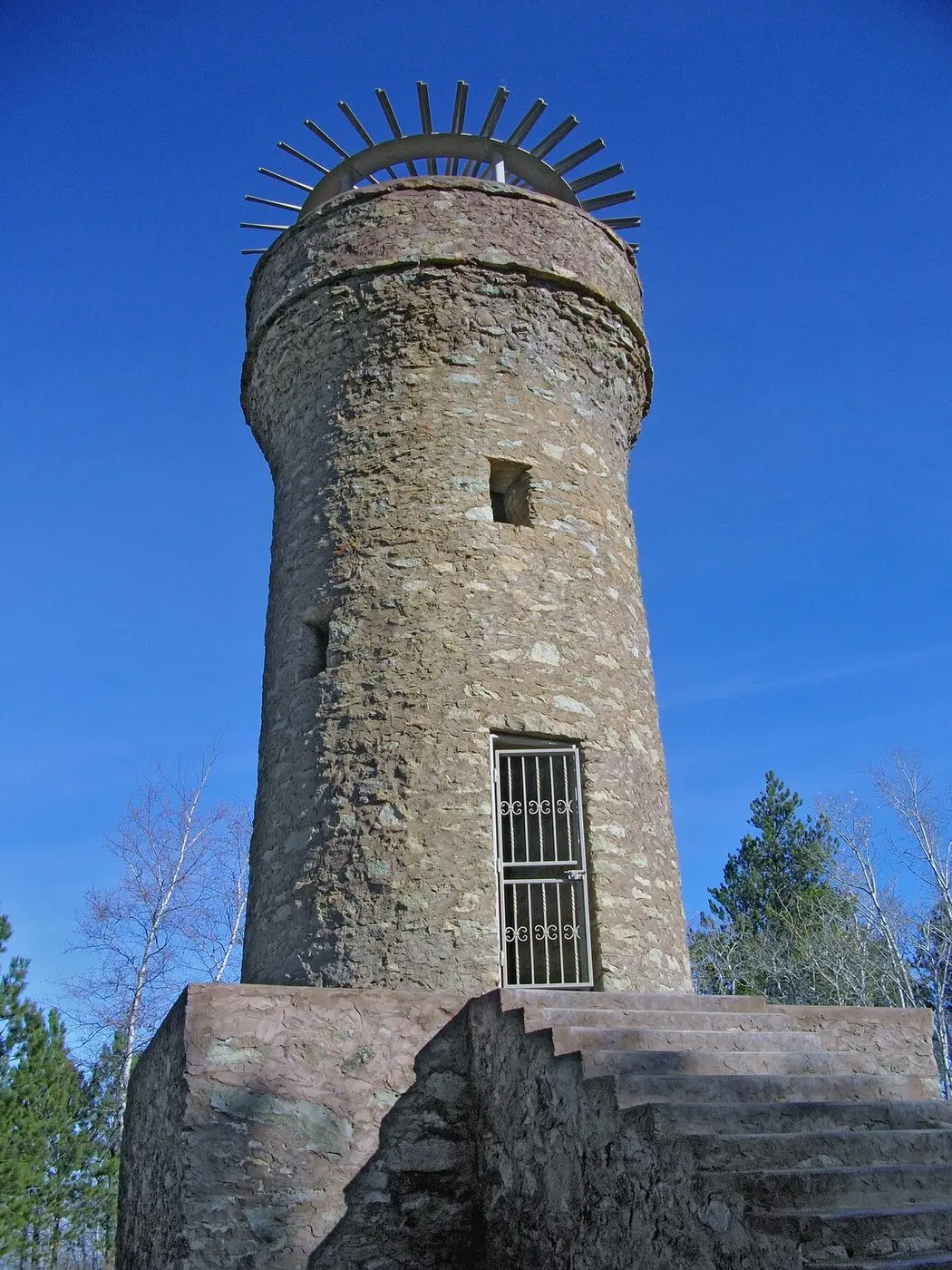
U.S. Department of Agriculture, CC BY 2.0 After Roosevelt died that January, Seth Bullock and the Society of Black Hills Pioneers renamed Sheep Mountain and built a stone tower on it, which the city describes as the first monument to the late president. Bullock died on September 23 that same year. His burial plot above Mount Moriah has a view of the monument across the gulch.
Read more: Seth Bullock, Mount Moriah Cemetery
Sources: Mt. Roosevelt Tower: A Brief History, City of Deadwood Archives, Seth Bullock brochure, City of Deadwood Archives, Timeline of Deadwood, South Dakota, City of Deadwood Historic Preservation Office
August 15, 1924The first Days of '76
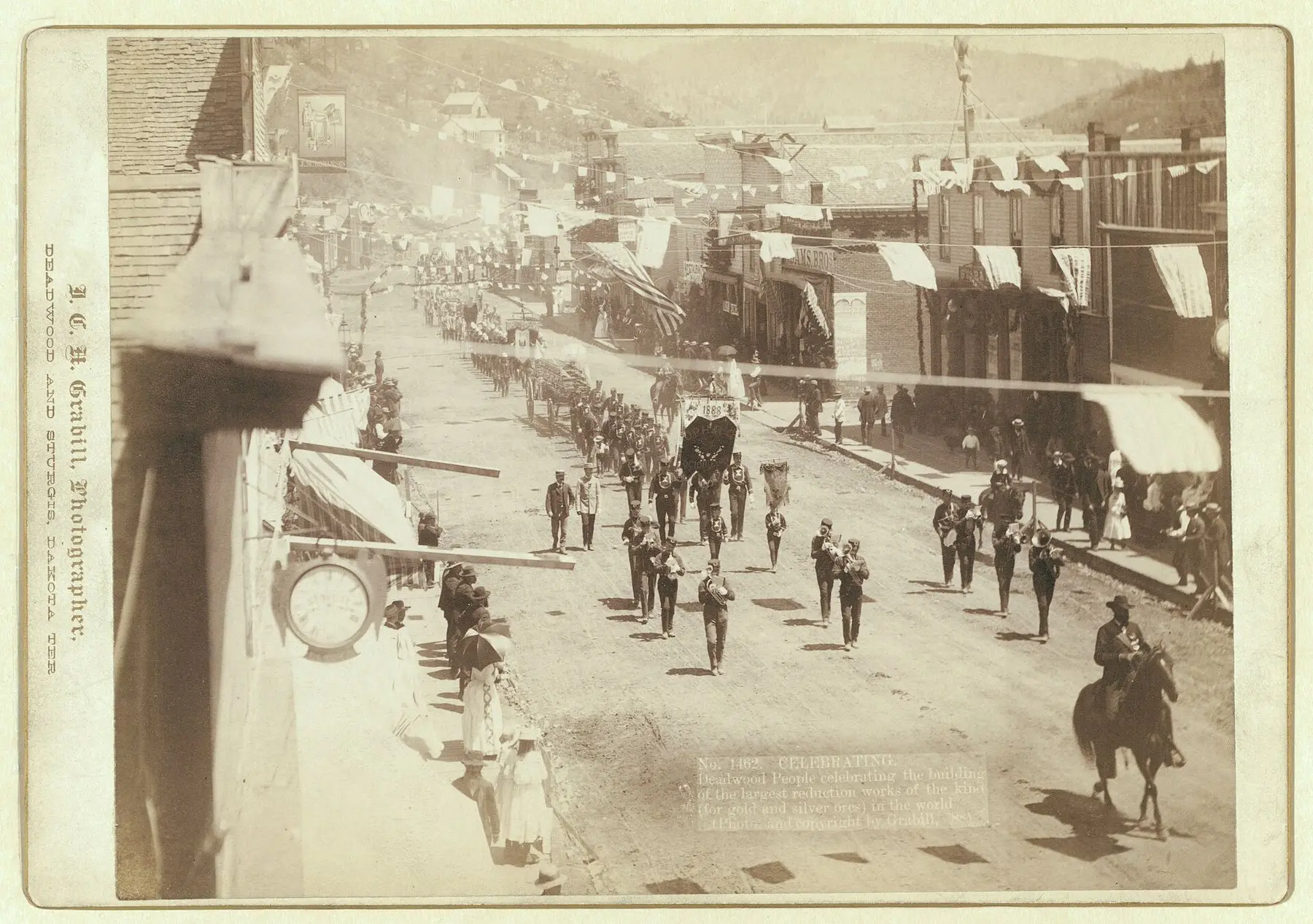
John Grabill, public domain With its boom long past, Deadwood opened its first Days of '76 celebration, turning its own history into an attraction. President Coolidge took part in the event on August 4, 1927. Old-timers joined in too; Poker Alice Tubbs wore her khaki shirt and campaign hat in the early parades. A dedicated Days of 76 Museum opened in May 2013.
Read more: Alice "Poker Alice" Ivers Tubbs
Sources: Timeline of Deadwood, South Dakota, City of Deadwood Historic Preservation Office, Dakota Images: Alice Ivers Tubbs, South Dakota History 40:1
May 27, 1929Potato Creek Johnny's nugget
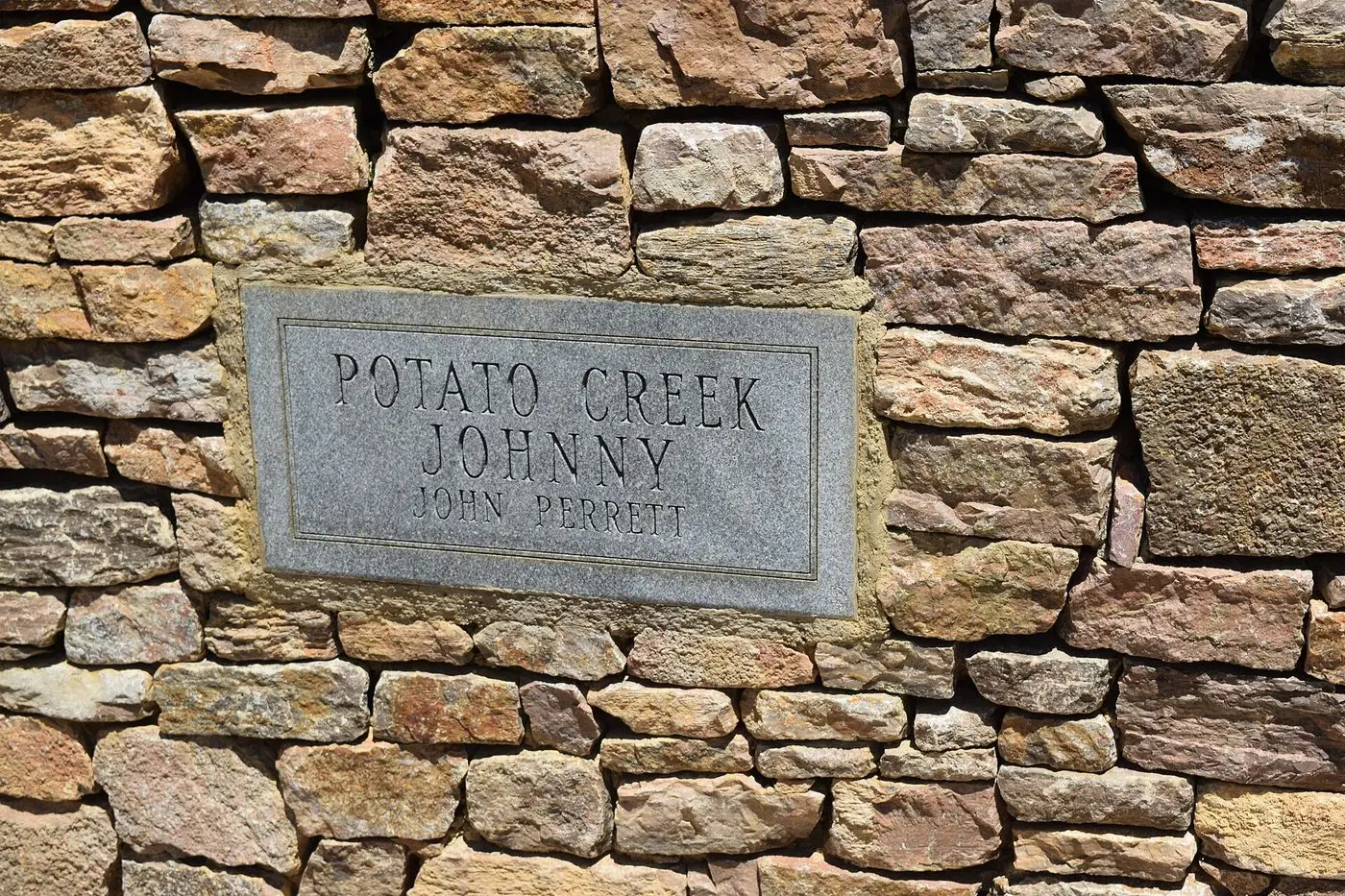
John Manard, CC BY-SA 2.0 John Perrett, a tiny Welsh-born prospector known to everyone as Potato Creek Johnny, found a gold nugget of about 7.3 troy ounces on his claim. In 1934 he sold it for $250 to W.E. Adams for display. Doubters thought it might be melted gold, but experts say its natural quartz crystals point to the real thing. Weights vary slightly by source.
Read more: John "Potato Creek Johnny" Perrett, William Emery "W.E." Adams
Sources: Potato Creek Johnny and the PCJ Gold Nugget, South Dakota Public Broadcasting, Potato Creek Johnny, Wikipedia
October 3, 1930The Adams Museum
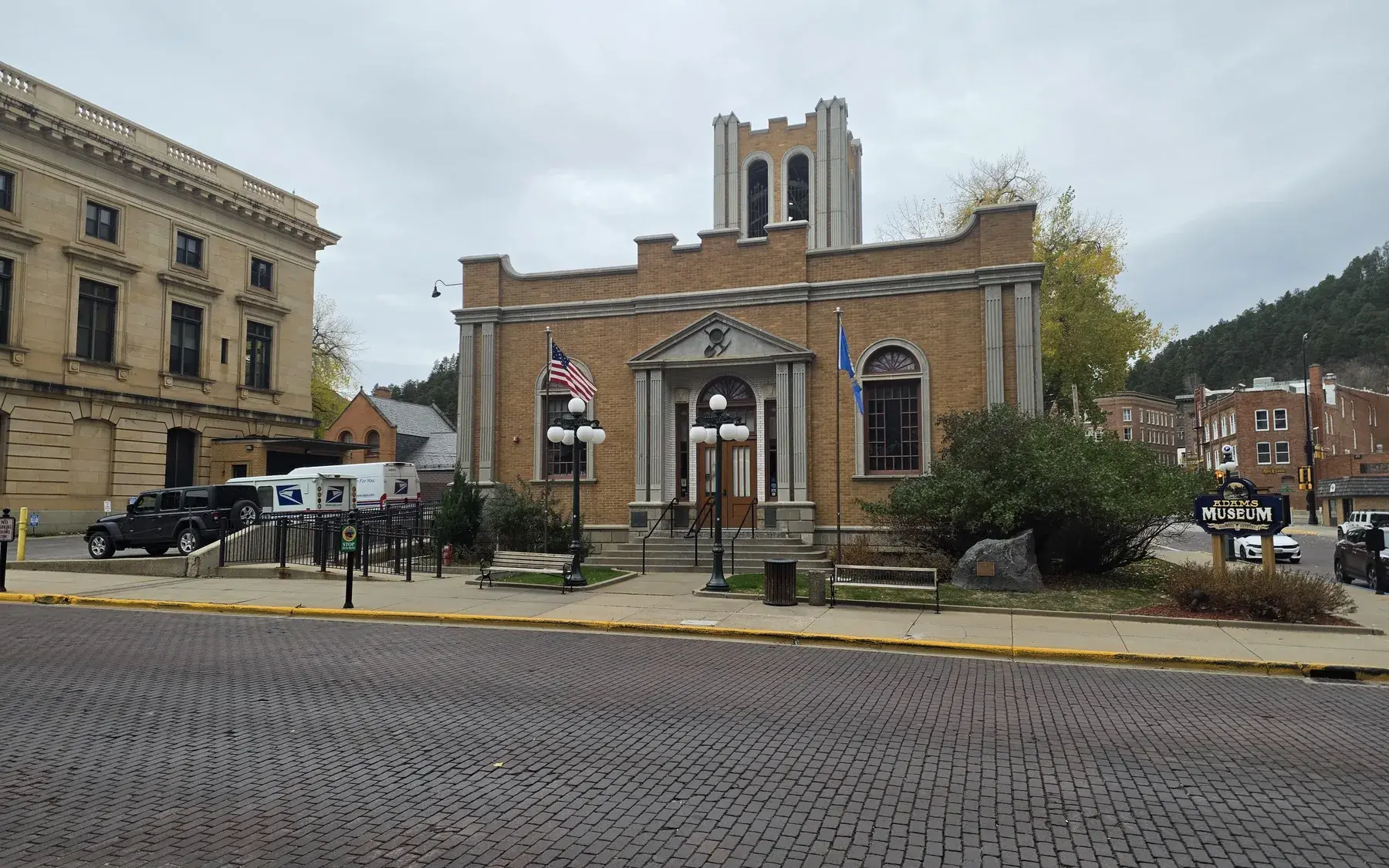
W.E. Adams, a grocer turned wholesaler and six-term mayor, financed a museum and presented it to the city. It honored the Black Hills pioneers and his late first wife and two daughters. The city calls it the first established museum in the Black Hills. Adams said it would be free to the public; Deadwood History, Inc. operates it today.
Read more: William Emery "W.E." Adams
Sources: Timeline of Deadwood, South Dakota, City of Deadwood Historic Preservation Office, The Man Behind the Museum: W.E. Adams, South Dakota Public Broadcasting, The Deadwood Legacy of W.E. Adams, South Dakota Public Broadcasting, Adams Museum, City of Deadwood
Decline & Preservation
Hard times and a landmark designation.
1947The state shuts the tables
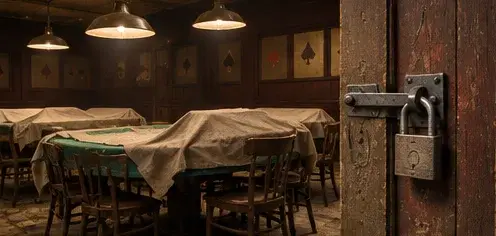
AI-generated illustration, not a historical photo. Gambling had run openly or behind closed doors in Deadwood for decades, and flourished again after Prohibition ended. In 1947 the state attorney general had the county sheriff crack down, and the city marks that year as the official end of gambling in town. Forty-two years would pass before the tables legally came back, this time to pay for preservation.
Read more: How Legal Gaming Came to Deadwood
Sources: Timeline of Deadwood, South Dakota, City of Deadwood Historic Preservation Office, The Town That Took a Chance, American Heritage
July 4, 1961A National Historic Landmark
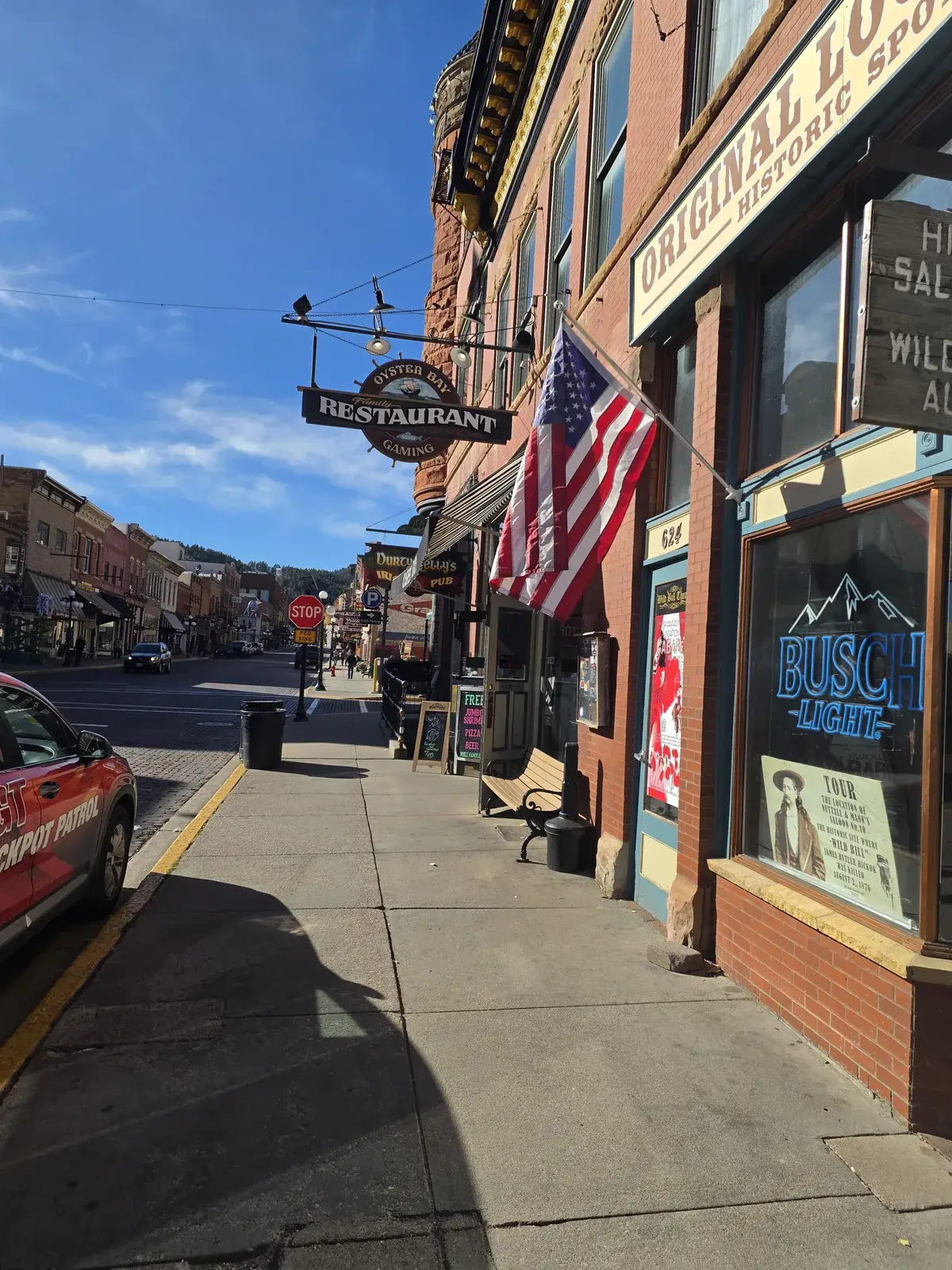
The Department of the Interior designated Deadwood a National Historic Landmark. A bronze plaque followed on July 3, 1963, mounted on the Adams Museum. The boundaries were later debated: a 1976 Park Service study focused on the commercial core, and the 1985 National Register nomination extended the district to the city limits, arguing that homes and mining structures were integral to the town's story.
Read more: Fire, Flood and Rebuilding
Sources: Timeline of Deadwood, South Dakota, City of Deadwood Historic Preservation Office, A National Historic Landmark, City of Deadwood, Deadwood Historic District, National Historic Landmark nomination, National Park Service, Deadwood Historic District National Register nomination form (1985), City of Deadwood, With Old West charm, Deadwood draws people in, The Municipal (quotes Deadwood's preservation officer: July 4, 1961)
Mid-1960sA physics experiment in a gold mine
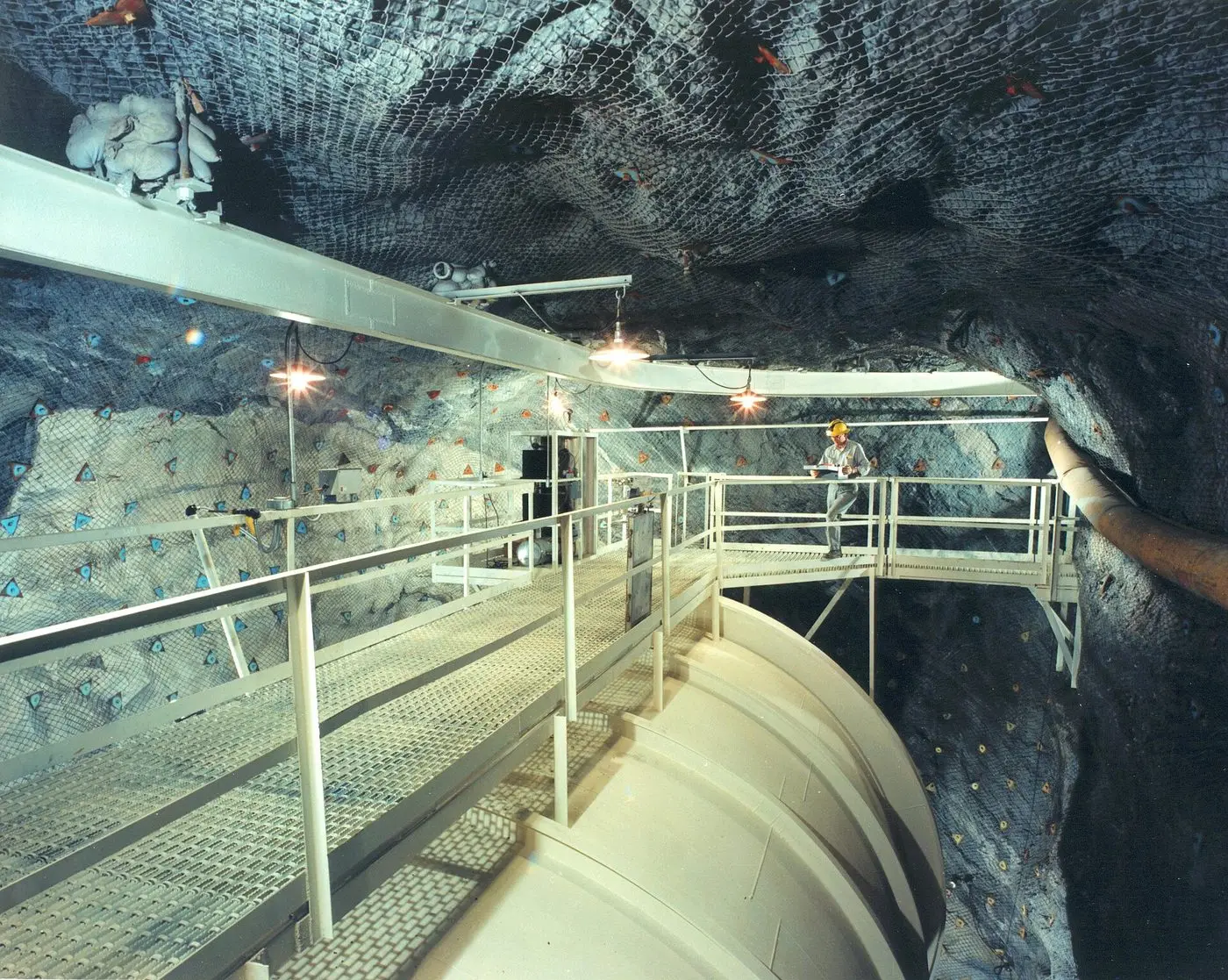
U.S. Department of Energy, public domain Raymond Davis Jr. built a 100,000-gallon detector on the 4850 Level of the Homestake Mine to catch neutrinos from the sun. It was the first experiment to observe them, and Davis received the Nobel Prize in 2002. Above him the mine went on producing gold for decades, but the work underground pointed toward another future for the site.
Read more: The Homestake: Gold, Lead and a Company Town
Sources: Our Story, Sanford Underground Research Facility, Homestake Mine (South Dakota), Wikipedia
May 21, 1980The last raid
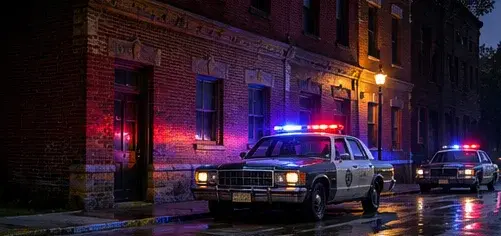
AI-generated illustration, not a historical photo. Authorities raided and padlocked Deadwood's remaining brothels, the final closure of a trade more than a century old. American Heritage names Pam's Purple Door as the last to close. The city's timeline notes that most such establishments had already been shut by the state's attorney during the 1950s and 1960s. The town now had neither its old vices nor much of an economy.
Read more: How Legal Gaming Came to Deadwood
Sources: Timeline of Deadwood, South Dakota, City of Deadwood Historic Preservation Office, The Town That Took a Chance, American Heritage, Deadwood, South Dakota, Wikipedia
June 30, 1980United States v. Sioux Nation
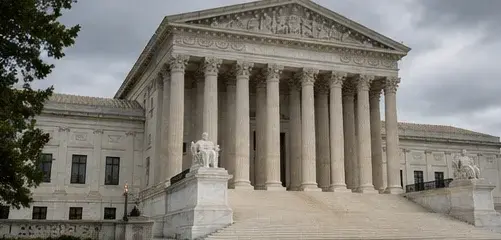
AI-generated illustration, not a historical photo. The Supreme Court held that the 1877 Act was a taking requiring just compensation: $17.1 million, the Hills' 1877 value, plus interest. Accounts of the total at the time range from $102 million to $106 million. The Sioux have refused the money, now more than $1 billion held in trust. Accepting it, tribal leaders say, would amount to selling what was never for sale.
Read more: Paha Sapa: The Lakota Homeland
Sources: United States v. Sioux Nation of Indians, 448 U.S. 371 (1980), Legal Information Institute, Why the Sioux Are Refusing $1.3 Billion, PBS NewsHour, Rosebud tribe battles Black Hills lawsuit, ICT, "We are all mitakuye oyasin," Sanford Underground Research Facility
December 15, 1987The Syndicate Block fire
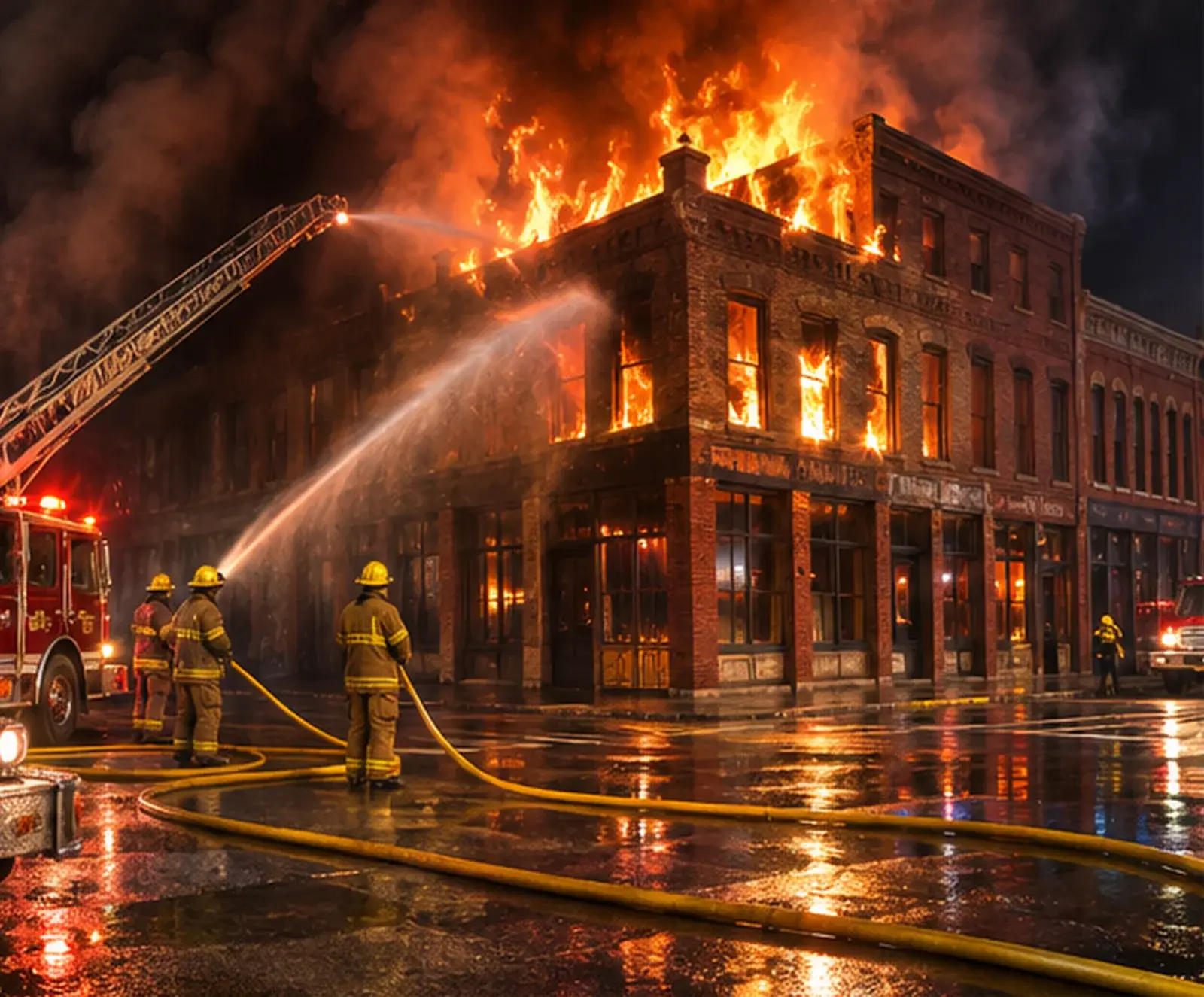
AI-generated illustration, not a historical photo. Fire destroyed three buildings along Main Street. It came the same year Deadwood established a Historic Preservation Commission, whose projects, American Heritage reports, were expected to take 40 years to finance. The city's records call the Syndicate Block fire the rallying cry for legalized gaming. Historian David Wolff ranks it with the fires of 1879, 1889 and 1894.
Read more: How Legal Gaming Came to Deadwood, Fire, Flood and Rebuilding
Sources: Timeline of Deadwood, South Dakota, City of Deadwood Historic Preservation Office, The Town That Took a Chance, American Heritage, South Dakota History explores Deadwood fires, South Dakota Historical Society Foundation
Gaming & Modern Deadwood
The 1989 vote and the town today.
November 8, 1988South Dakota votes yes
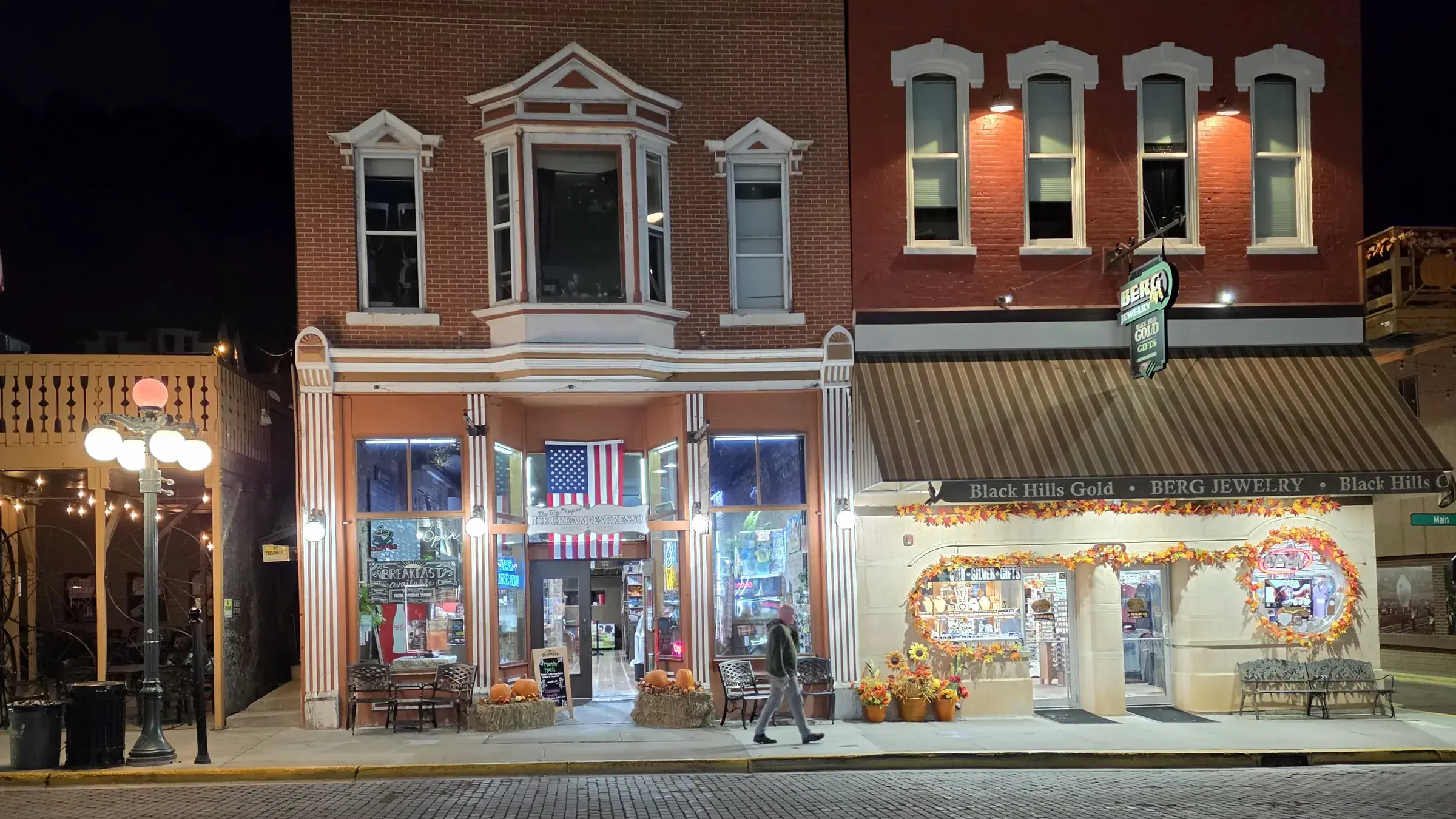
Sixty-four percent of South Dakota voters approved a constitutional amendment allowing limited gambling in Deadwood, with proceeds tied to historic preservation. American Heritage rounds it to nearly two to one. The following April, Deadwood's own voters backed it by about three to one, while High Country News notes the legislature passed its enabling act the same month.
Read more: How Legal Gaming Came to Deadwood
Sources: In 30 years, gaming has revitalized and challenged Deadwood, South Dakota News Watch, Deadwood pays dearly for gambling riches, High Country News, The Town That Took a Chance, American Heritage
November 1, 1989Five-dollar bets
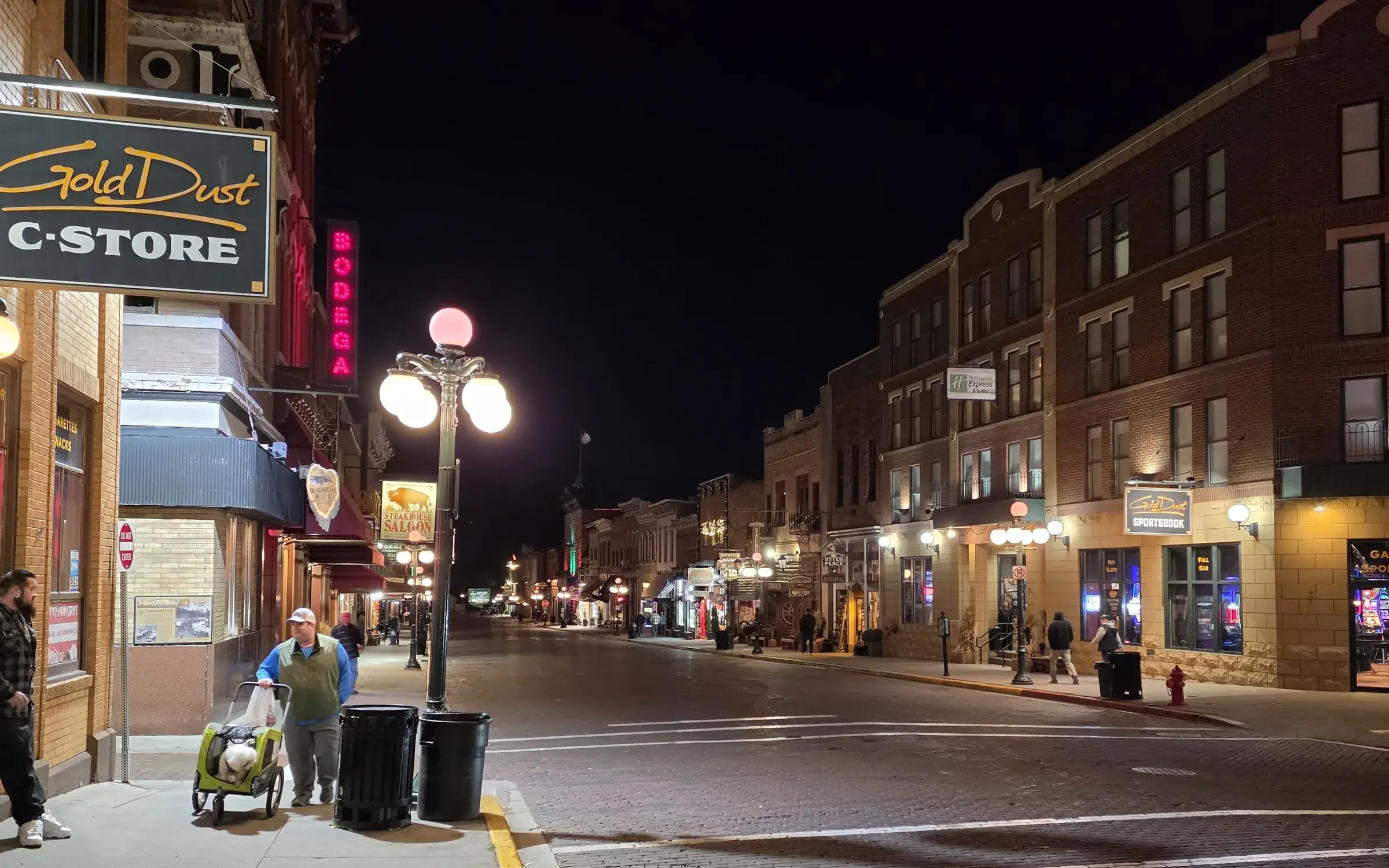
Deadwood became the third legal gaming jurisdiction in the United States, after Nevada and Atlantic City. Consultants expected $2 million in wagers the first year; bettors placed $13.8 million in the first month, at a $5 limit. The limit rose to $100 in 2000 and to $1,000 in 2012. A two-year restoration of Main Street was completed in June 1992.
Read more: How Legal Gaming Came to Deadwood, Fire, Flood and Rebuilding
Sources: In 30 years, gaming has revitalized and challenged Deadwood, South Dakota News Watch, Anniversary of gambling in Deadwood, KOTA, Timeline of Deadwood, South Dakota, City of Deadwood Historic Preservation Office, Gaming history FAQ, Deadwood Chamber of Commerce ($5 to $100 in 2000; $100 to $1,000 in 2012), South Dakota Register, December 11, 2000 (rules for Initiated Measure One, $100 maximum wagers)
Summer 2001Digging up Chinatown
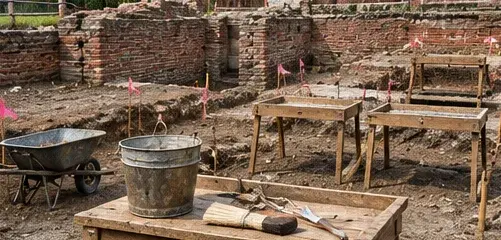
AI-generated illustration, not a historical photo. Preservation funding opened an archaeological investigation of Deadwood's Chinatown after a lower Main Street building was razed. The State Archaeological Research Center found intact foundations, a privy and rich artifact deposits. Excavations ran through 2003. Then, on December 24, 2005, the historic Wing Tsue building was demolished in violation of the preservation ordinance; bricks from it later went into a rebuilt cemetery altar.
Read more: Fire, Flood and Rebuilding, Mount Moriah Cemetery
Sources: The Archaeology of Deadwood's Chinatown: A Prologue, South Dakota History 33:4, Timeline of Deadwood, South Dakota, City of Deadwood Historic Preservation Office, Mt. Moriah Cemetery brochure, City of Deadwood Archives
2000 to 2001The Homestake closes
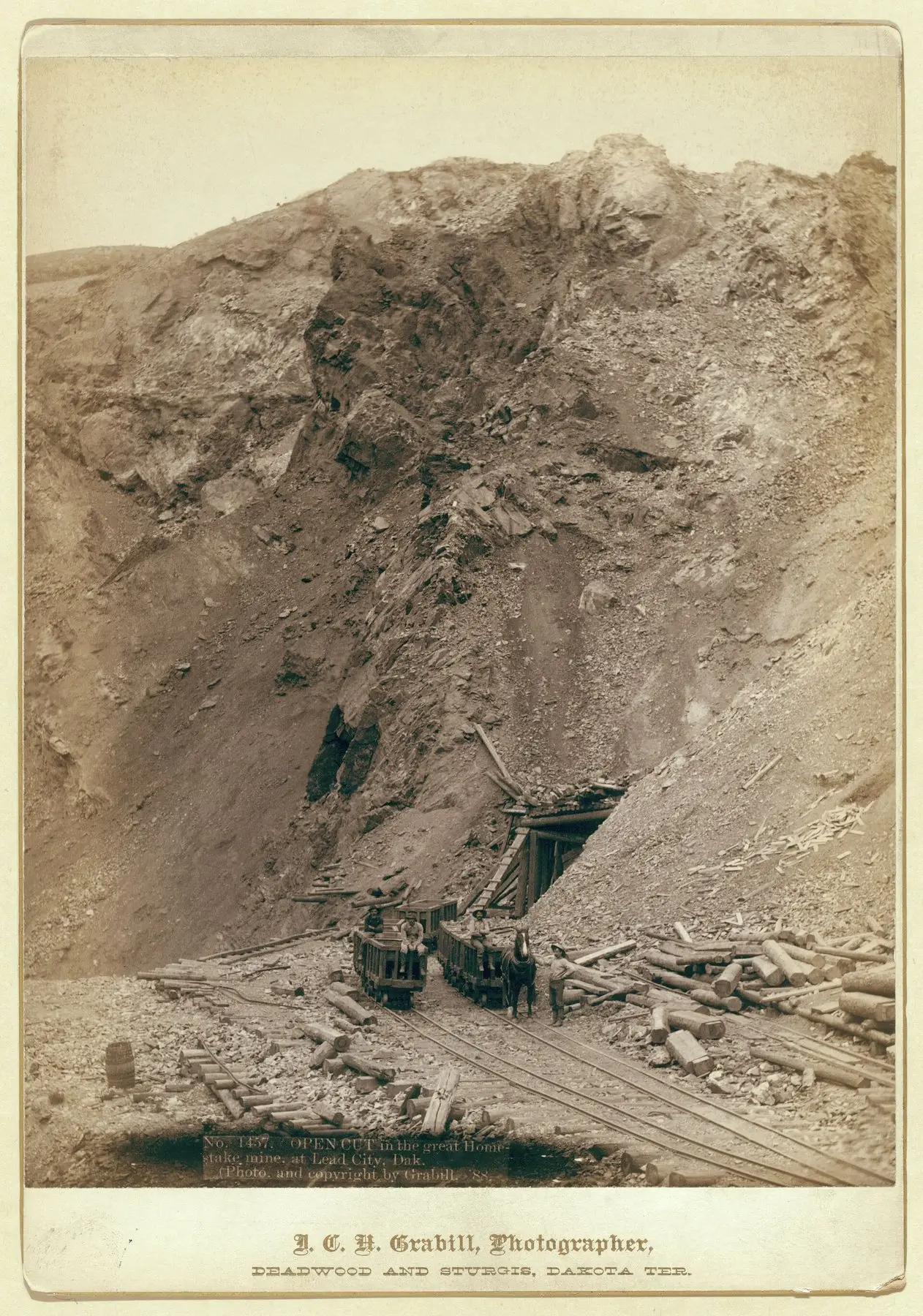
John Grabill, public domain On September 11, 2000, Homestake announced that it would stop mining. The last gold ore came out on December 14, 2001, and operations ceased that month as the company merged with Barrick. Some accounts, including Sanford Lab's and South Dakota News Watch's, date the closing to 2002. Lifetime totals run from about 39 million to 41 million ounces. Jobs and residents left the northern Hills.
Read more: The Homestake: Gold, Lead and a Company Town
Sources: Homestake Mine announces it would cease gold mining operations, South Dakota Public Broadcasting, Homestake Mine, Encyclopedia of the Great Plains, Homestake Mine (South Dakota), Wikipedia, Our Story, Sanford Underground Research Facility, In 30 years, gaming has revitalized and challenged Deadwood, South Dakota News Watch, Timeline of Deadwood, South Dakota, City of Deadwood Historic Preservation Office
June 29 to July 8, 2002Grizzly Gulch fire
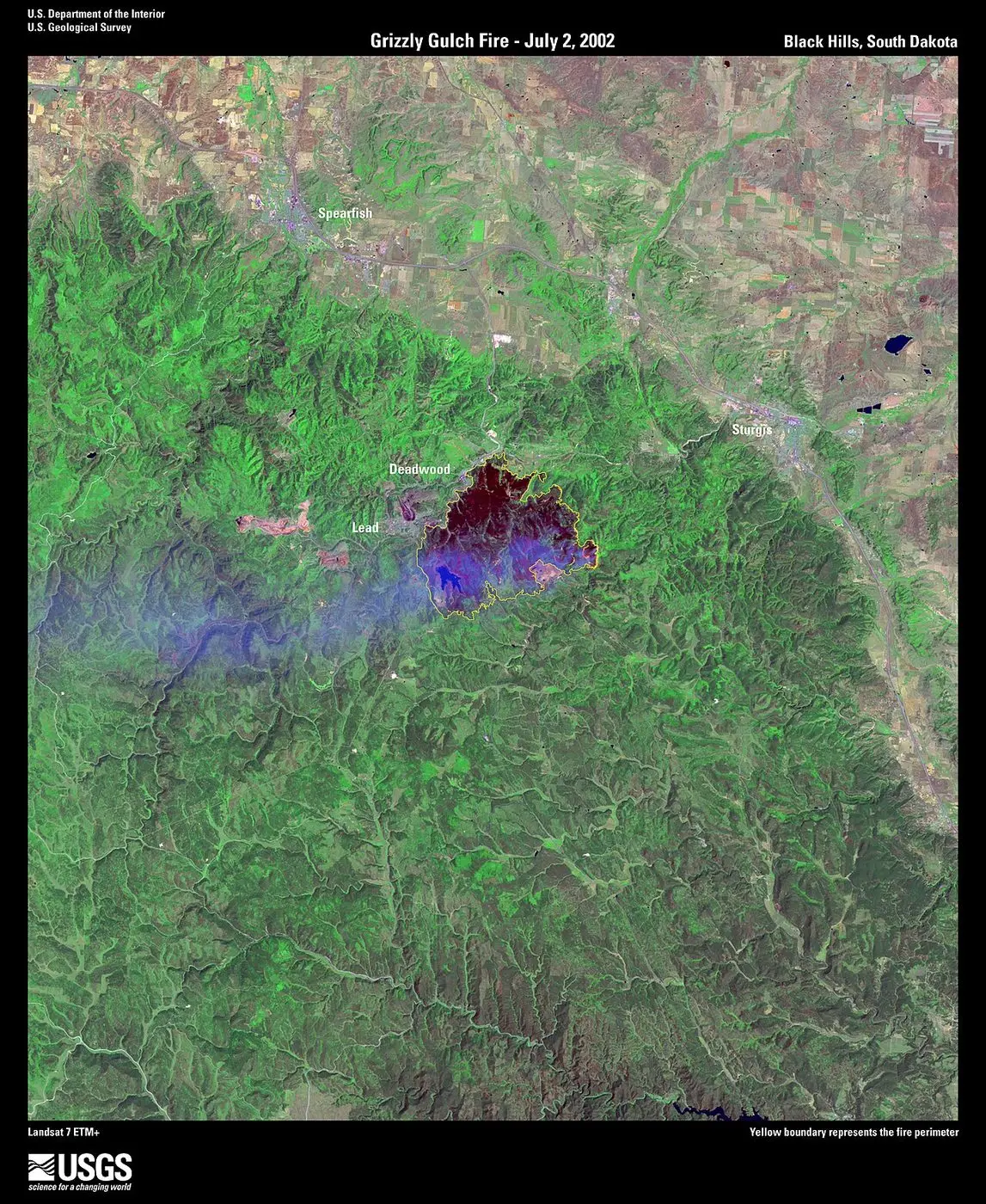
USGS EROS Data Center, public domain A wildland fire burned over 11,000 acres and threatened the town itself. American Heritage recalls a wildfire forcing a whole-town evacuation on twenty minutes' notice, stopped at the highway by slurry bombers, but dates it to June 2001; the city's date for Grizzly Gulch is the following summer. An earlier blaze, on September 8, 1959, had burned over 4,000 acres.
Read more: Fire, Flood and Rebuilding
Sources: Timeline of Deadwood, South Dakota, City of Deadwood Historic Preservation Office, The Town That Took a Chance, American Heritage
August 2, 2002Mount Moriah restored
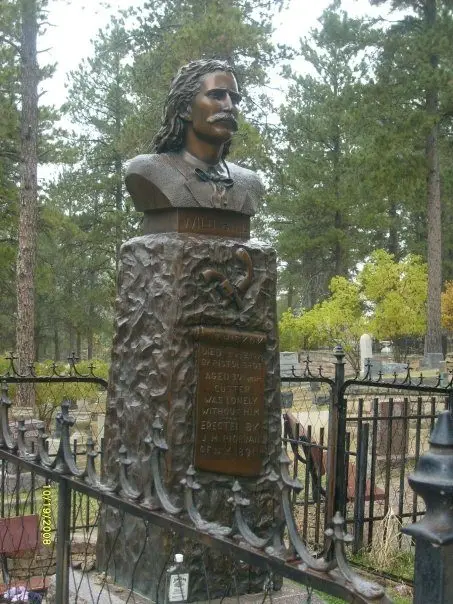
Louisvillejg, CC BY-SA 3.0 A bronze marker modeled on the 1890 Hickok monument was unveiled, completing a $4.8 million restoration of Mount Moriah Cemetery paid for with preservation money from gaming. Crews repaired broken monuments, rebuilt retaining walls and paved the roads. The cemetery had closed to new burials in 1949 and began charging admission in the mid-1980s to help cover its upkeep.
Read more: James Butler "Wild Bill" Hickok, Mount Moriah Cemetery, How Legal Gaming Came to Deadwood
Sources: Timeline of Deadwood, South Dakota, City of Deadwood Historic Preservation Office, Mt. Moriah Cemetery brochure, City of Deadwood Archives
March 21, 2004HBO's Deadwood premieres
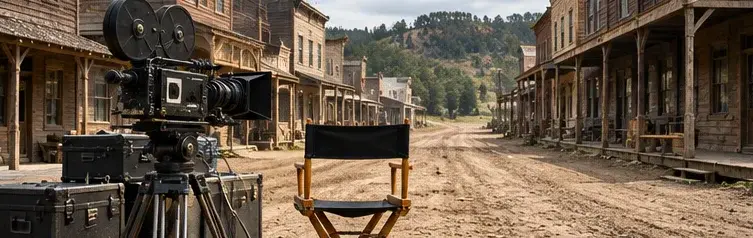
AI-generated illustration, not a historical photo. David Milch's series ran three seasons and 36 episodes to August 27, 2006, shot largely at Melody Ranch in California. Real people appear with heavy fictional license. It won eight Emmys from 28 nominations, and a film followed on May 31, 2019, in which Charlie Utter is killed in 1889. The real Utter died in Panama in 1915. Adams Museum visitors rose 37 percent in 2004.
Read more: Seth Bullock, Ellis Albert "Al" Swearengen, James Butler "Wild Bill" Hickok, Martha "Calamity Jane" Canary, Ethan Bennett "E.B." Farnum, Charles H. "Colorado Charlie" Utter, HBO's Deadwood and the Real Deadwood
Sources: Deadwood (TV series), Wikipedia, 25 Things You Didn't Know About Deadwood, Mental Floss, The Town That Took a Chance, American Heritage, Charlie Utter, Wikipedia, Behind the Scenes of Deadwood: The Movie, Cowboys & Indians
2006 to 2007From gold mine to underground lab
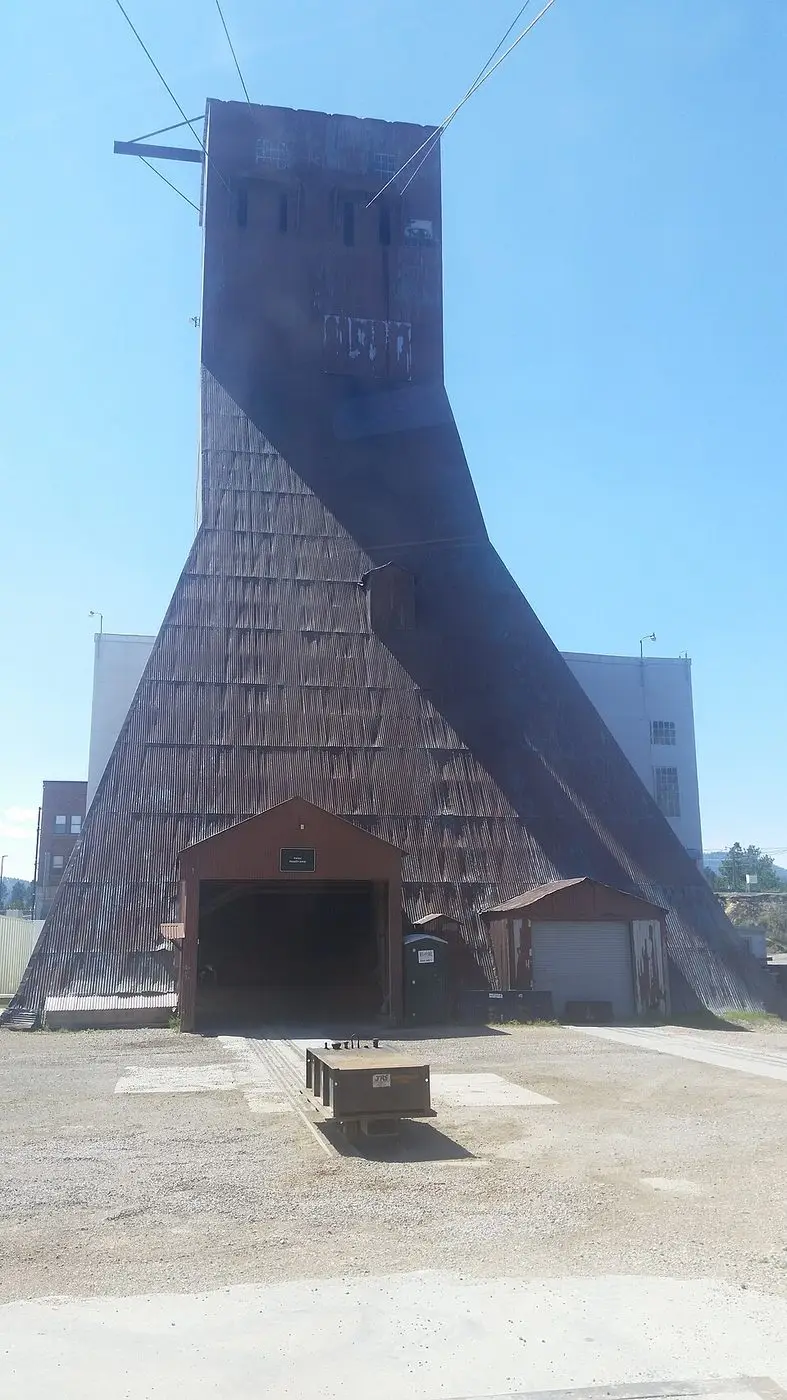
Pi3.124, CC BY-SA 4.0 T. Denny Sanford pledged $70 million in 2006, Barrick donated land, and the state committed more than $40 million. By 2007 the site was on course to become today's Sanford Underground Research Facility, with experiments about a mile down. Lakota scholar Jace DeCory has noted that many saw the lab as further desecration, while adding that, since the ground was already dug out, something positive should come of it.
Read more: The Homestake: Gold, Lead and a Company Town, Paha Sapa: The Lakota Homeland
Sources: Our Story, Sanford Underground Research Facility, "We are all mitakuye oyasin," Sanford Underground Research Facility
2012 and 2016Buying back Pe' Sla
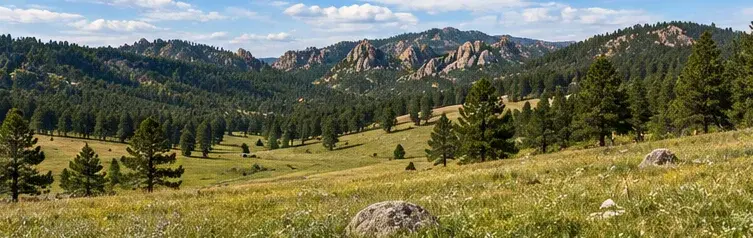
AI-generated illustration, not a historical photo. When Pe' Sla, a sacred site in the Hills, came up for sale in 2012, Sioux tribes raised $9 million to buy it, including over $900,000 in online gifts. Reports vary on which tribes contributed and on the acreage. In March 2016 the Bureau of Indian Affairs decided to take 2,022 acres into trust. That August, the state's highest peak was renamed Black Elk Peak.
Read more: Paha Sapa: The Lakota Homeland
Sources: Tribes raise $9M for sacred SD land, MPR News, Pe' Sla trust decision, Indianz.com, Lakota land returns to trust status, South Dakota Public Broadcasting, Black Elk, National Park Service
December 12, 2019Outlaw Square opens
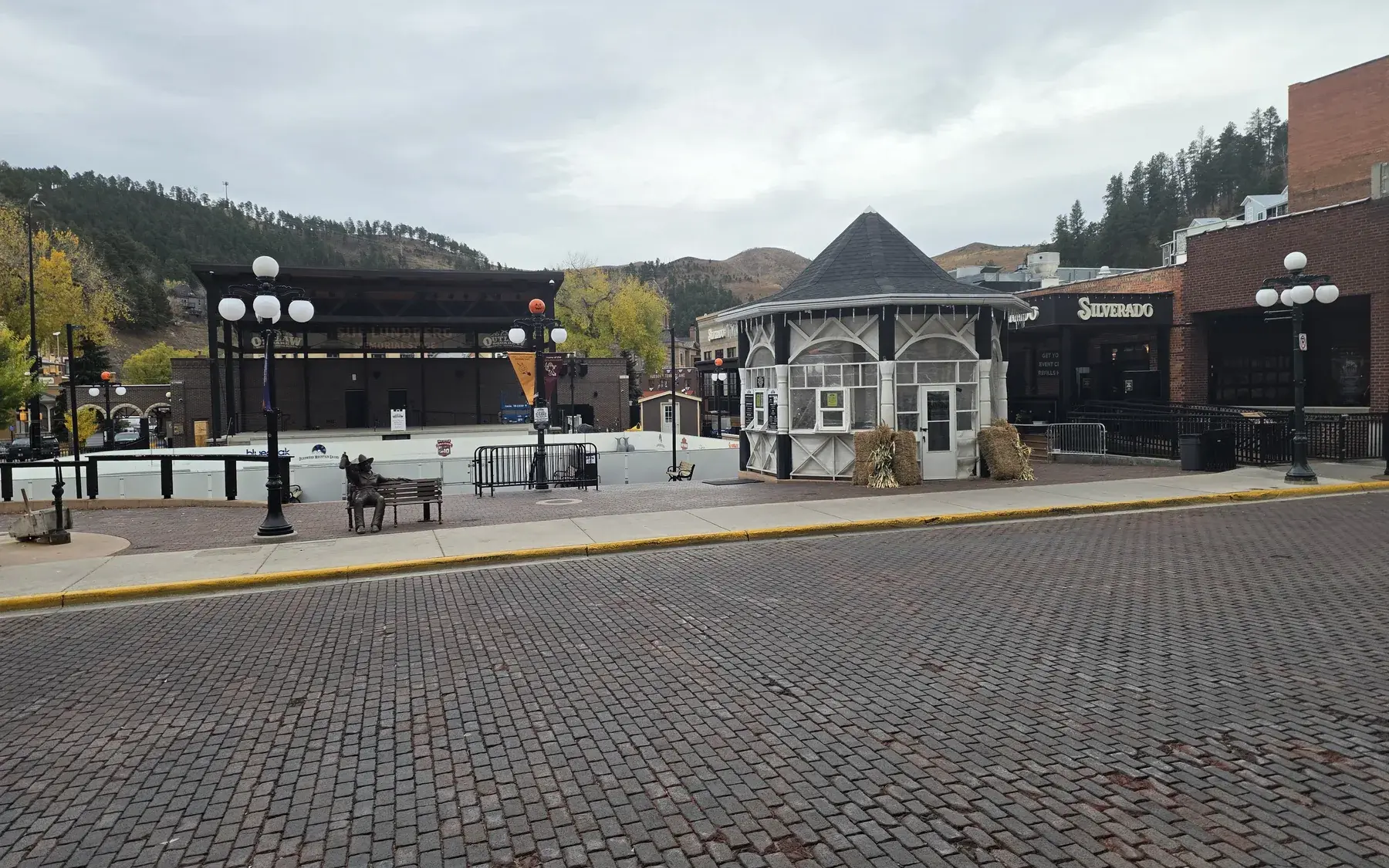
Deadwood opened a new public gathering place on Main Street, where the old City Hall and theater stood until 1952. Funded by the Historic Preservation Commission and the state, work began in autumn 2018. The grand opening included a Christmas tree lighting and free ice skating. The city notes the site lies less than 100 feet from the creeks where gold was found in late 1875.
Read more: How Legal Gaming Came to Deadwood
Sources: Outlaw Square, City of Deadwood, Deadwood to hold grand opening ceremony for Outlaw Square, KOTA
2026150 years
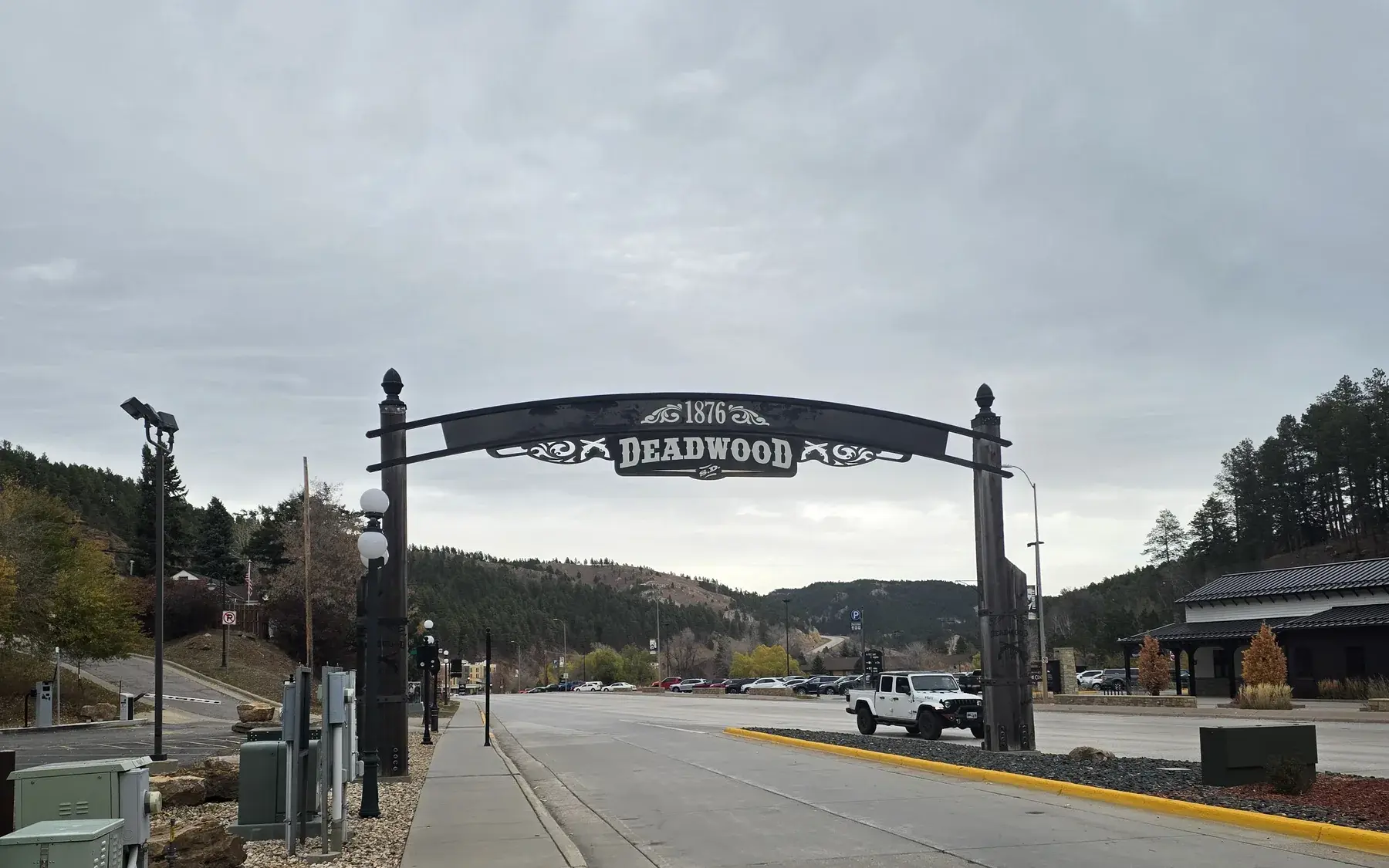
Deadwood marked its sesquicentennial with a year of events. On August 2 and 3, actors recreated Hickok's shooting at Saloon No. 10 and his funeral at Outlaw Square. On October 1, a time capsule went into the Adams Museum lawn, to be opened in 2076. The city's own account says the town began as an unauthorized settlement on land reserved for the Lakota.
Read more: James Butler "Wild Bill" Hickok
Sources: City of Deadwood's Sesquicentennial Celebration, Deadwood commemorates 150th anniversary of Wild Bill Hickok's death, KOTA, Deadwood buries time capsule for 150th anniversary, Dakota News Now