
The Homestake: Gold, Lead and a Company Town
For about 125 years the Homestake Mine in nearby Lead was the economic engine of the northern Black Hills. What it made, who paid, and what became of it.
Deadwood gets the famous names, but three miles up the road in Lead was the operation that kept the northern Black Hills going for more than a century. The Homestake Mine became, by the Sanford Lab’s account, the largest and deepest gold mine in North America. It also sits on land that the Lakota have never agreed to give up.
Claims and capital
In 1876 Moses and Fred Manuel, with Alex Engh and Hank Harney, found the deposit that became the Homestake. The following year a syndicate of California capitalists, George Hearst, Lloyd Tevis and James Ben Ali Haggin, bought the Golden Star and Homestake claims for $70,000. Hearst reached Deadwood in October 1877. The original claims covered about ten acres.
That purchase changed the region. By July 1878 an 80-stamp mill was crushing ore. The company sold shares and listed on the New York Stock Exchange in 1879, according to one source, though another dates its NYSE entry to 1977. By 1900 it held 300 claims on 2,000 acres and employed more than 2,000 people. By 1999 it held more than 8,000 acres of patented claims.
Hearst left the Black Hills in March 1879.
Under the ground
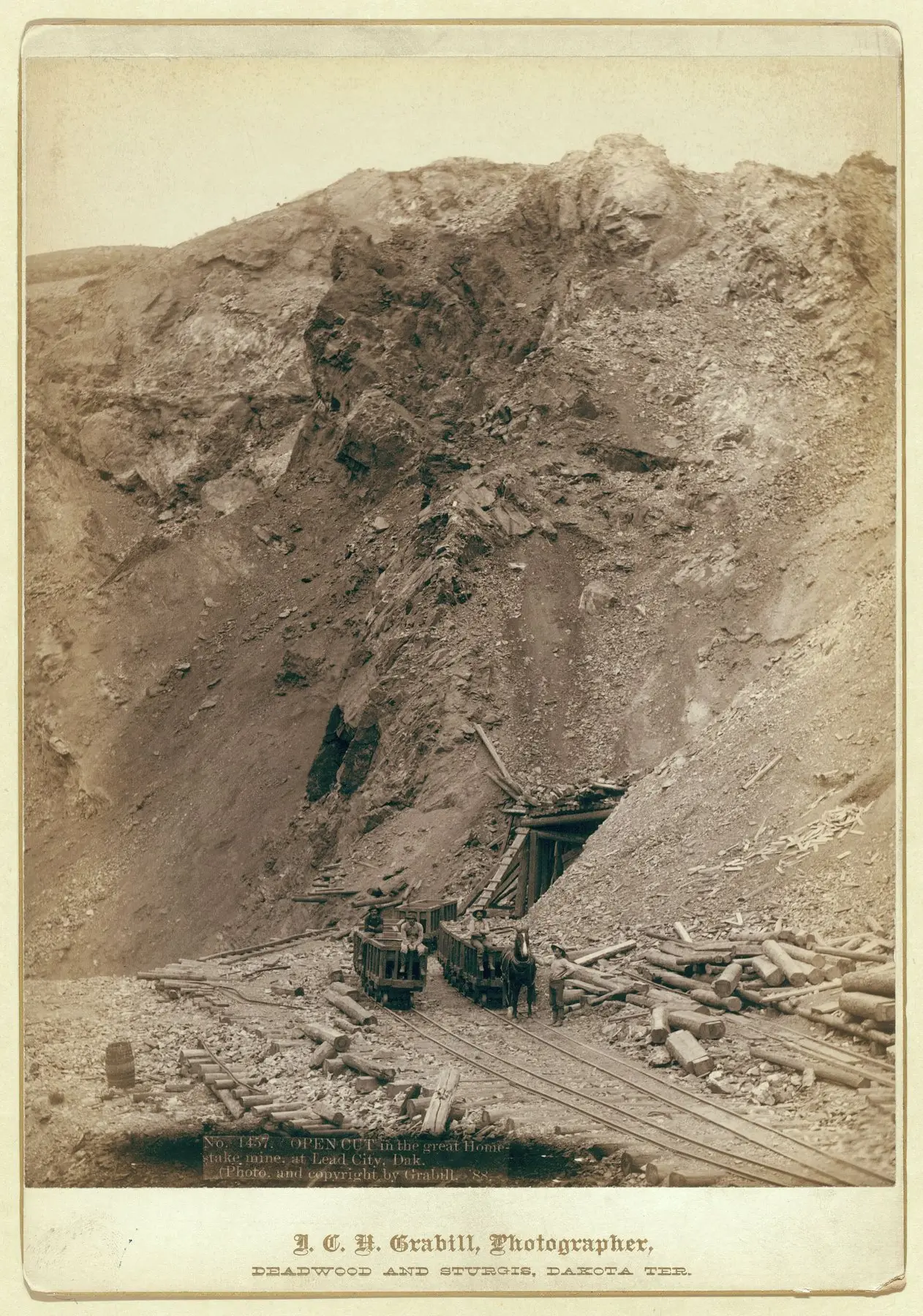
The mine went down in stages, with shafts sunk over decades, including Ross in 1934 and Yates in 1938. It reached the 6,800-foot level by 1975 and ultimately 8,000 feet. It also had a big surface excavation, the Open Cut that photographer John Grabill recorded in the 1880s.
Mining was dangerous. A fire that broke out on March 25, 1907, took forty days to put out and required flooding parts of the mine. Another bad fire came in 1919. Before 1918 deaths averaged about 18 per year, according to South Dakota Public Broadcasting. During World War II, a War Production Board order halted work from 1943 to 1945.
The environmental cost lasted longer. Whitewood Creek served as a dump for tailings and municipal waste for nearly 100 years. In the 1990s the company spent nearly $100 million on reclamation at what became a Superfund site. The Sacred Land Film Project also criticizes cyanide heap-leach mining in the Hills and estimates the natural resources extracted from them at $4 billion.
The lockout
In late 1909 the Western Federation of Miners pushed to bring in all eligible workers, and members resolved not to work beside anyone who had not joined by November 25.
Superintendent Thomas J. Grier responded first. He locked out the workforce on November 24, hired more than 100 guards and Pinkerton detectives, and recruited workers from other states. Men could only come back by signing a register that barred them from union membership. The lockout ended on January 8, 1910, and by March 3 the mine was back at full production with more than 1,000 stamps running. South Dakota Public Broadcasting describes it as lasting 54 days, although its own dates run about 45.
The victory came with a kind of company paternalism. In 1910 Homestake set up free medical services for workers and dependents and an aid fund. A 7 percent bonus followed in 1912, and an Opera House and Recreation Building was given to the city of Lead in 1914. A safety department was established in 1916, and annual deaths fell to one or two. The first wage increase since 1877 came in 1917. The mine stayed non-union until the United Steelworkers won a narrow vote in 1966.
Beyond gold
Homestake only mined gold until the 1950s and 1960s, when it moved into uranium, lead and zinc. In the early 1980s it bought gold mines in Australia and Canada.
Beneath Lead, Homestake also became an unusual place for science. In the mid-1960s Raymond Davis Jr. built a 100,000-gallon detector on the 4850 Level to catch solar neutrinos. It was the first experiment to observe them, and he received the Nobel Prize in 2002.
Closing
Gold prices fell, ore grades declined and costs rose. On September 11, 2000, the company announced that it would cease mining. The last gold ore came out on December 14, 2001, and mining operations ceased on December 31 as Homestake merged with Barrick Gold. Some accounts date the closing to 2002, and the pumps were switched off in June 2003. South Dakota News Watch notes the job losses and population decline that followed. Lifetime output is given variously as more than 39 million, 39.8 million and about 41 million ounces, and the mine also produced about 9 million ounces of silver.
A lab, and a question
In 2004 the state formed the South Dakota Science and Technology Authority to study turning the mine into a research lab. In 2006 T. Denny Sanford pledged $70 million, Barrick donated land and the state committed more than $40 million. After the National Science Foundation pulled back in 2010, the Department of Energy stepped in, and the Sanford Underground Research Facility now hosts dark matter and neutrino experiments on the old levels, with more than 370 miles of tunnels.
At a talk there in 2015, Lakota scholar Jace DeCory set out the larger context: the 1868 treaty, the seizure of the Hills and the Sioux refusal of payment. Many people, she acknowledged, saw the lab as further desecration. “I believe that since it is already dug out,” she said, “we should make something positive out of it.” Over 126 years, the lab’s account of her talk notes, the mine took more than 41 million ounces of gold from land the Lakota call the heart of everything.
Sources
- Homestake Mine, Encyclopedia of the Great Plains
- Homestake Mine (South Dakota), Wikipedia
- Our Story, Sanford Underground Research Facility
- Homestake Mine announces it would cease gold mining operations, South Dakota Public Broadcasting
- The Homestake Mining Company Lockout, South Dakota Public Broadcasting
- "We are all mitakuye oyasin," Sanford Underground Research Facility
- Black Hills, Sacred Land Film Project
- Deadwood Historic District, National Historic Landmark nomination, National Park Service
- In 30 years, gaming has revitalized and challenged Deadwood, South Dakota News Watch
- Timeline of Deadwood, South Dakota, City of Deadwood Historic Preservation Office
- History and Culture, Wind Cave National Park, National Park Service