
James Butler "Wild Bill" Hickok
1837-1876. Scout, lawman and gambler; killed in Deadwood
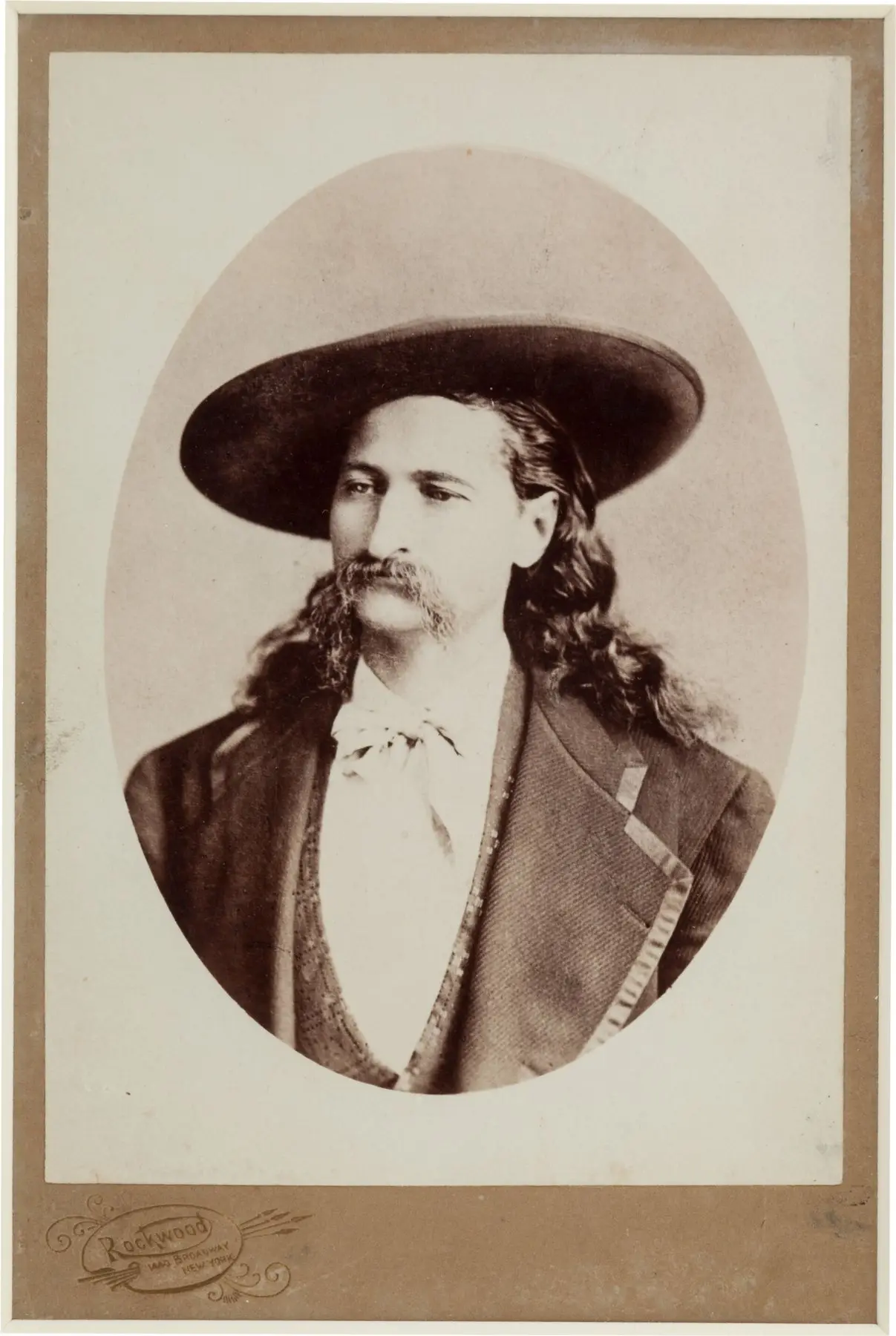
James Butler Hickok was born on May 27, 1837, in Homer, Illinois, now called Troy Grove, and grew up on the family farm. In the Civil War years he served the Union as a teamster, wagon master and scout, and by 1861 he was calling himself “Wild Bill.”
The legend and the count
Much of his fame was manufactured while he was alive. An 1867 article in Harper’s New Monthly Magazine, based on an interview with George Ward Nichols, claimed he had killed hundreds of men, and newspapers of the day disputed it. His biographer Joseph Rosa counts six or seven killings, all between 1861 and 1871. HistoryNet puts it at probably fewer than ten. The documented episodes are grim enough: the shooting of David McCanles at Rock Creek in 1861, a duel with Davis Tutt in Springfield, Missouri, in 1865, for which a jury acquitted him, and a fight in Abilene, Kansas, in 1871 in which he accidentally killed his own deputy, Mike Williams. He was relieved of his post as Abilene’s marshal less than two months later.
Deadwood
He married the circus proprietor Agnes Lake in Cheyenne on March 5, 1876, then left to join Charlie Utter’s wagon train. The party reached the gulch in June or July, depending on the source. South Dakota Public Broadcasting gives him about a month in town.
On August 2, 1876, Jack McCall shot him from behind in Nuttal and Mann’s No. 10 Saloon. The funeral and burial took place the next day. The famous “dead man’s hand” of black aces and eights is a matter of tradition: the City of Deadwood’s own brochure says the actual composition of his final hand remains an unresolved mystery. Nor was he clearly linked to Calamity Jane by anything beyond a few weeks’ acquaintance, whatever their shared graveside suggests.
After death
In August 1879 Utter moved the remains to Mount Moriah. In 1890 citizens commissioned a memorial, and a bronze in its likeness has marked the plot since August 2, 2002. Deadwood commemorated the 150th anniversary of the shooting on August 2 and 3, 2026.
Sources
- James Butler "Wild Bill" Hickok brochure, City of Deadwood Archives
- Wild Bill Hickok, Wikipedia
- Deadwood commemorates 150th anniversary of Wild Bill Hickok's death, KOTA
- Timeline of Deadwood, South Dakota, City of Deadwood Historic Preservation Office
- Wild Bill Hickok in Deadwood, South Dakota Public Broadcasting
- The Real Men of Deadwood, HistoryNet
- A Western Shootist Is Born, True West Magazine